Ipamorelin Peptide: What It Is, Dosage, Benefits and Side Effects

By Jeff NunnPublished · 15 min read
Ipamorelin is a five-amino-acid peptide that makes the pituitary release one short pulse of growth hormone. Most of what you read about its dosing comes from vendor and clinic pages, not from trials.
Here is the short version before the details:
- What it is: a growth hormone secretagogue that acts on the ghrelin receptor, the same receptor the hunger hormone uses.[1][3]
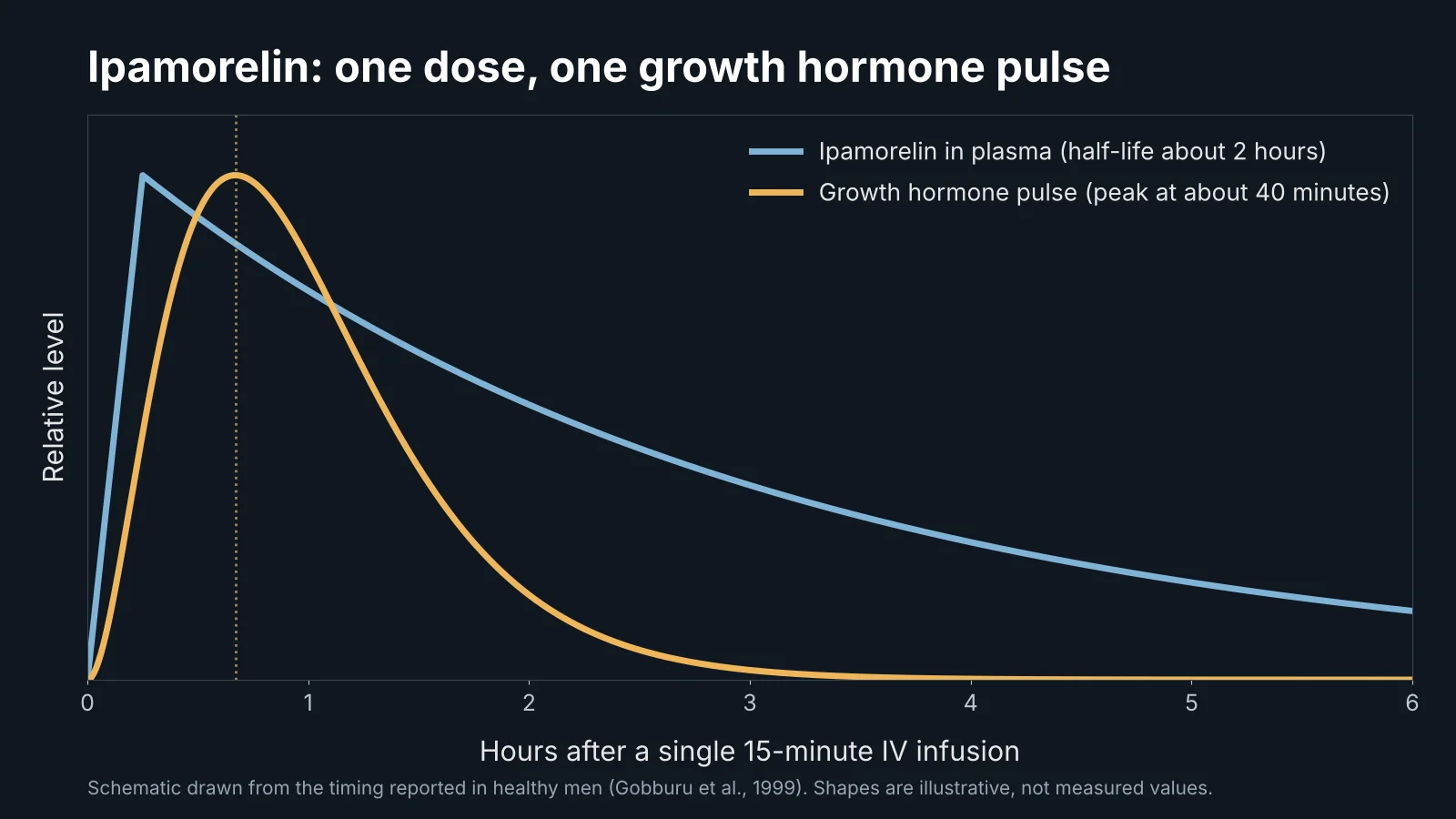
- Half-life: about 2 hours in healthy men, with the growth hormone peak at about 40 minutes.[2]
- Doses tested in people: intravenous only. No published study has tested the under-the-skin injections people actually use.[3][4]
- Common clinic dose: clinics commonly use 200 to 300 mcg per injection, given under the skin.
- Side effects: the only published patient trial called it well tolerated, but the FDA lists it as a compounding substance with significant safety risks.[3][5]
- Legal status: not FDA approved, and banned in tested sport.[4][9]
What Is Ipamorelin?
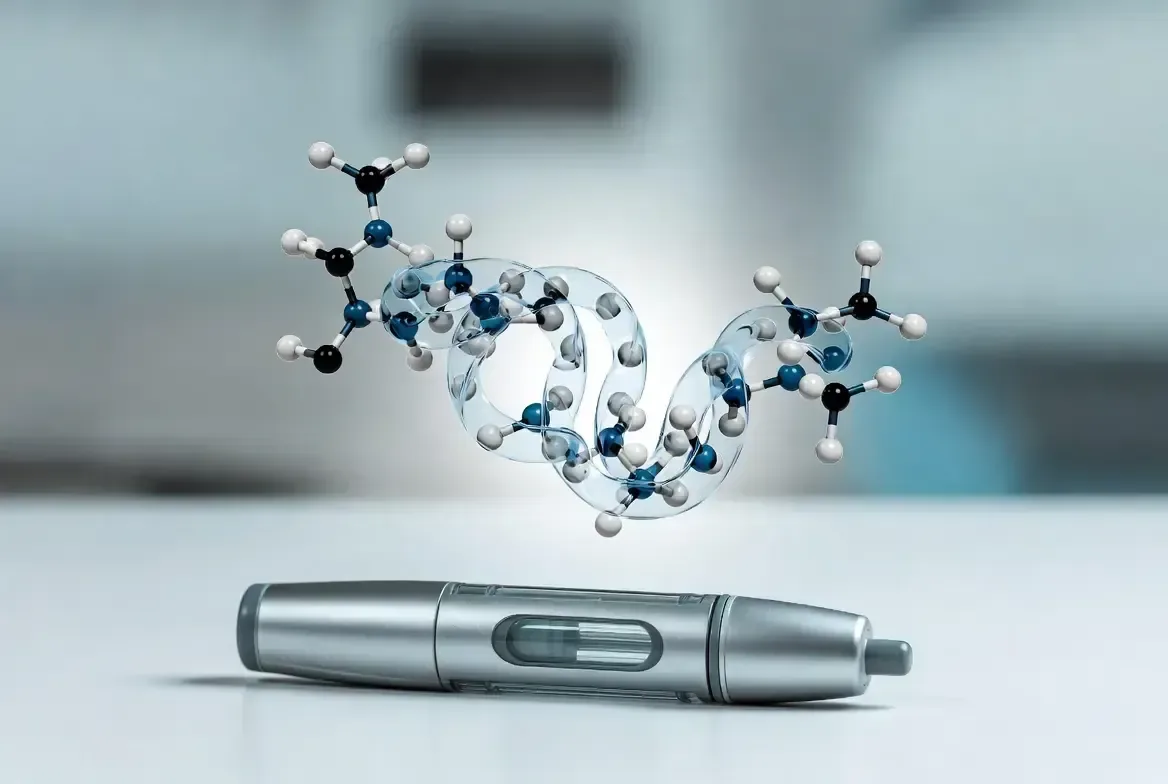
Ipamorelin is a synthetic pentapeptide with the sequence Aib-His-D-2-Nal-D-Phe-Lys-NH2.[1] Scientists at Novo Nordisk found it while working through a series of growth hormone-releasing peptides (GHRPs), the class that also includes GHRP-2 and GHRP-6.[1]
What set it apart was selectivity. The team titled the 1998 paper that introduced it "Ipamorelin, the first selective growth hormone secretagogue."[1] It released growth hormone about as well as GHRP-6 without the stress-hormone spillover the older peptides caused.
The amino acids marked "D" and "Aib" are not the ones your body builds proteins from. The FDA has pointed to those unnatural amino acids as one reason ipamorelin is hard to test and characterize as a compounded product.[5]
How Ipamorelin Works in the Body
Ipamorelin binds the growth hormone secretagogue receptor on the pituitary gland. That is a different door than the one used by growth hormone-releasing hormone (GHRH) and its copies, such as CJC-1295, sermorelin and tesamorelin.[1]
The response is a pulse, not a steady rise. In healthy men given a 15-minute intravenous infusion, ipamorelin produced a single episode of growth hormone release that peaked at 0.67 hours, about 40 minutes, then fell to negligible levels at every dose tested.[2] The peptide itself had a terminal half-life of 2 hours.[2]
Why Selectivity Is the Selling Point
In swine, GHRP-6 and GHRP-2 both raised adrenocorticotropic hormone (ACTH) and cortisol. Ipamorelin did not, even at doses more than 200 times higher than the dose needed for half its growth hormone effect.[1] None of the peptides tested changed FSH, LH, prolactin or TSH.[1]
That is the source of the "clean growth hormone peptide" reputation repeated across the web. Keep the species in mind. The selectivity data come from pigs and rats. The main human study measured growth hormone, not cortisol or prolactin.[2]
Ipamorelin Dosage: What the Studies Actually Used
Search for an ipamorelin dosage and you will find the same per-injection numbers repeated across vendor and clinic sites. Those numbers come from clinical practice, not from a human trial, because no published trial tested ipamorelin under the skin in people. The FDA's 2024 review said it found no pharmacokinetic or pharmacodynamic information for the subcutaneous route.[4]
This section gives both: the doses the studies used, then the doses clinics list. One study used intravenous infusions in hospital inpatients [2][3].
Ipamorelin Dosage Chart From Published Studies
| Study | Who | Route and dose | Length | What it showed |
|---|---|---|---|---|
| Gobburu 1999 [2] | Healthy men, 8 per dose level | IV over 15 minutes, five levels from 4.21 to 140.45 nmol/kg (about 3 to 100 mcg/kg) | Single dose | Half-life 2 hours; one growth hormone pulse peaking at 40 minutes |
| Beck 2014 [3] | 114 adults after bowel surgery | IV, 0.03 mg/kg (30 mcg/kg) twice daily | Up to 7 days | Well tolerated; did not speed recovery of gut function |
| Johansen 1999 [6] | Adult female rats | Under the skin, 18 to 450 mcg per day split into three injections | 15 days | Faster leg bone growth and weight gain, dose dependent |
| Lall 2001 [7] | Mice | Under the skin, twice daily | 2 to 9 weeks | About 15% body weight gain and more body fat |
The microgram figures for the Gobburu study are converted from nanomoles using ipamorelin's molecular weight of about 712. For an 80 kg adult, the Beck trial dose works out to 2.4 mg per infusion.
Two points follow from the table. First, the human doses were given into a vein, which delivers the whole dose at once, so they do not translate directly to an injection under the skin. Second, rat and mouse doses never transfer to people by body weight alone.
Common Clinic Ipamorelin Dosage
Clinics commonly use 200 to 300 mcg per injection, given under the skin. Clinics commonly give it one to three times daily. Clinics commonly run a cycle of 8 to 12 weeks on, then 4 weeks off.
Clinics commonly give a single dose at bedtime, on an empty stomach. The bedtime habit is meant to line the pulse up with the natural growth hormone release during sleep.
Read these numbers for what they are: the doses clinics use, not doses a trial tested for safety or results. Also keep in mind that the FDA's advisory committee voted against letting pharmacies compound ipamorelin, as covered below.[9]
How Much Ipamorelin Per Day?
Clinics commonly give one to three injections a day. For a single nightly injection, clinics commonly use 200 to 300 mcg before bed.
The half-life is the one hard number that shapes those schedules. A peptide with a 2-hour half-life is mostly gone within a day, so it does not build up from one dose to the next.[2] That is why people who use it inject daily rather than weekly, and why it is often compared with the long-acting CJC-1295 with DAC.
Converting a Dose to Syringe Units
Most dosing mistakes are math mistakes, not peptide mistakes. The concentration depends on how much bacteriostatic water goes into the vial. A 5 mg vial mixed with 2 mL of water holds 2.5 mg per mL, so 10 units on a U-100 insulin syringe (0.1 mL) carries 250 mcg. Change the water and every unit means something different.
Walk through the method in our guide to peptide concentration, then check your numbers with the ipamorelin dosage calculator. The calculator takes the vial size, the water you added and the dose, and returns the syringe units.
The water matters as much as the math. Read up on bacteriostatic water for peptides before you mix anything. Mixed vials also need cold storage, and the peptide storage after reconstitution guide covers how long they hold.
Ipamorelin Benefits: What Has Actually Been Measured
Benefit lists for ipamorelin usually read like benefit lists for growth hormone itself: muscle, fat loss, recovery, sleep, skin. Here is what the ipamorelin studies measured, separated from what is assumed.
Growth hormone release in people. Measured and confirmed. Ipamorelin released growth hormone at every intravenous dose tested in healthy men.[2]
Bone growth. Measured in rats only. Three daily injections for 15 days increased the growth rate of the shin bone in a dose-dependent way, from 42 to as much as 52 micrometers a day.[6] Blood IGF-1 did not change in that study.[6]
Gut recovery after surgery. Tested in people and not proven. Patients on ipamorelin tolerated a solid meal at a median of 25.3 hours versus 32.6 hours on placebo, but the difference was not statistically significant (p = 0.15).[3]
Fat loss. The animal data point the other way. In mice, twice-daily ipamorelin raised body weight about 15% and increased body fat, even in mice that cannot make growth hormone. In normal mice it also increased food intake.[7]
Sleep, muscle and recovery. Not studied for ipamorelin. These claims rest on what growth hormone does in general and on user reports, such as the case in our post on peptides for athletic performance. If sleep is the goal, compare it with a peptide that has been studied for sleep, such as DSIP.
A 2026 review in Frontiers in Endocrinology put it plainly: for the growth hormone peptides sold online, the evidence runs from regulatory-grade trials for a few compounds to no human studies at all for others, and the performance and body-recomposition benefits remain uncertain.[8]
Ipamorelin Side Effects and Safety
In the bowel surgery trial, side effects of any kind were reported by 87.5% of patients on ipamorelin and 94.8% on placebo, and the authors called the drug well tolerated.[3] Those were hospital patients recovering from major surgery [3], a different setting than a healthy adult injecting at home.
The FDA reads the same record more cautiously. Its list of compounding substances that may present significant safety risks includes ipamorelin acetate, for three stated reasons:[5]
- Immune reactions. Clumped peptide (aggregation) and peptide-related impurities may trigger an immune response.
- Hard to test. The unnatural amino acids make the peptide harder to characterize.
- A serious event signal. A published study reported serious adverse events, including death, when ipamorelin was given intravenously for gut motility.
The FDA did not conclude that ipamorelin caused those deaths. It listed them as a concern alongside the lack of safety data for other injection routes.[5]
Side Effects Reported With Growth Hormone Peptides
The 2026 Frontiers in Endocrinology review grouped the problems clinicians see in people self-injecting growth hormone peptides, ipamorelin included:[8]
- Hormone and metabolic changes: prolactin and cortisol rises, appetite changes and abnormal blood sugar
- Fluid retention
- Muscle and joint aches
- Injection-site reactions
The FDA's adverse event database held only two ipamorelin reports in its 2024 review, both non-serious and both from compounded products: headache and watery eyes from a nasal spray, and elbow joint pain from an ipamorelin and sermorelin injection.[4] Two reports is far too few to say how often side effects happen.
Does Ipamorelin Cause Weight Gain?
In animals, yes. Rats gained weight in a dose-dependent way, and mice gained about 15% body weight with more body fat and higher food intake.[6][7] Ipamorelin mimics ghrelin, the hunger hormone, so appetite effects are expected. Human appetite has not been measured in a published trial.
Ipamorelin vs Other Growth Hormone Peptides
The growth hormone peptides split into two receptor families. Ipamorelin, GHRP-2 and GHRP-6 work through the secretagogue (ghrelin) receptor. CJC-1295, sermorelin and tesamorelin copy GHRH and work through the GHRH receptor.
| Peptide | Receptor | Cortisol and ACTH in animal tests | FDA status |
|---|---|---|---|
| Ipamorelin | Secretagogue (ghrelin) | No meaningful rise [1] | Not approved |
| GHRP-6 | Secretagogue (ghrelin) | Raised [1] | Not approved |
| GHRP-2 | Secretagogue (ghrelin) | Raised [1] | Not approved |
| CJC-1295 | GHRH | Not tested in that study | Not approved |
| Tesamorelin | GHRH | Not tested in that study | Approved for one HIV-related use |
Because the two families use different receptors, ipamorelin is most often paired with a GHRH copy. The common pairing is CJC-1295 without DAC, and the second most discussed is ipamorelin with tesamorelin. No published trial has tested either combination for safety or results.
Ipamorelin is one of several peptides people use to move the growth hormone axis, and they differ in how long they act and how much human data stands behind them. For the wider picture, see our breakdown of the peptides studied for growth hormone signaling.
Is Ipamorelin Legal? FDA, Compounding and WADA Status
Ipamorelin is not approved by the FDA [10]. On October 29, 2024, the FDA's Pharmacy Compounding Advisory Committee voted 0 to 12, with one abstention, against putting ipamorelin acetate on the list of substances pharmacies may compound.[9] The FDA's safety risk page places it in Category 2 for outsourcing facilities.[5]
What that means for a prescription, a compounding pharmacy or a "research use only" vial is covered in our guide to compounding pharmacy peptides and our explainer on what research-only peptides really means.
For athletes the answer is simpler. The FDA's 2024 review notes that ipamorelin is on the World Anti-Doping Agency's prohibited list under section S2.4.[4] Athletes subject to testing can be sanctioned for using it.
Quality Is the Variable You Can Control
Every dosing table assumes the vial holds what the label says. A short, unstable peptide with unnatural amino acids is exactly the kind of product where purity, identity and fill amount drift from batch to batch. Our breakdown of third-party peptide testing shows how to read a certificate of analysis, and the research peptide companies we track are listed in one place with how each one documents its testing.
BioEdge Research Labs sells Ipamorelin as a single 10 mg vial (SKU IPA10) and in 3, 6 and 10-vial packs, with HPLC purity listed at 99% or higher and the batch certificate posted under the product's third-party testing section. The pack discounts apply on their own in the cart, and Project Biohacking's BioEdge Research Labs coupon code, PROBIO15, takes 15 percent off a BioEdge order at checkout.
Pack pricing that applies on its own can leave a code with nothing to add, depending on the store. How peptide discount codes interact with automatic pricing differs by vendor, so check the order summary.
Ipamorelin FAQ
What is ipamorelin used for?
Ipamorelin is used to trigger a pulse of growth hormone from the pituitary gland. It was developed by Novo Nordisk and tested in people for gut recovery after bowel surgery, where it did not beat placebo. It is not approved by the FDA for any use, and claims about muscle, fat loss and sleep come from growth hormone in general rather than from ipamorelin trials.
How much ipamorelin per day?
Clinics commonly use 200 to 300 mcg per injection, given under the skin. Clinics commonly give it one to three times daily. Those are clinic doses, not trial doses. The published human doses were intravenous: 4.21 to 140.45 nmol/kg infused over 15 minutes in healthy men, and 0.03 mg/kg twice daily for up to 7 days in surgical patients [2][3]. The FDA found no dosing data for injection under the skin.
What is the half-life of ipamorelin?
About 2 hours in healthy men. The growth hormone pulse it triggers peaks at about 40 minutes and falls to negligible levels afterward, so one dose produces one pulse.
Does ipamorelin cause weight gain?
In animal studies it did. Mice given ipamorelin twice daily gained about 15% body weight, with more body fat and higher food intake, and rats gained weight in a dose-dependent way. Appetite and weight have not been measured in a published human trial.
Is ipamorelin safer than HGH?
No study has compared the two head to head. Ipamorelin releases your own growth hormone in short pulses rather than adding hormone from outside, and in animal tests it did not raise cortisol. Its human safety record is limited to two small intravenous studies, and the FDA lists it as a compounding substance with significant safety risks.
Do I need to cycle off ipamorelin?
No ipamorelin trial has tested cycle length. Clinics commonly use 8 to 12 weeks on followed by 4 weeks off. It is practice, not a trial result.
References
- Raun K, Hansen BS, Johansen NL, et al. Ipamorelin, the first selective growth hormone secretagogue. Eur J Endocrinol. 1998;139(5):552-61. doi:10.1530/eje.0.1390552
- Gobburu JV, Agersø H, Jusko WJ, Ynddal L. Pharmacokinetic-pharmacodynamic modeling of ipamorelin, a growth hormone releasing peptide, in human volunteers. Pharm Res. 1999;16(9):1412-6. doi:10.1023/a:1018955126402
- Beck DE, Sweeney WB, McCarter MD. Prospective, randomized, controlled, proof-of-concept study of the ghrelin mimetic ipamorelin for the management of postoperative ileus in bowel resection patients. Int J Colorectal Dis. 2014;29(12):1527-34. doi:10.1007/s00384-014-2030-8
- U.S. Food and Drug Administration. Pharmacy Compounding Advisory Committee, October 29, 2024: briefing document on ipamorelin. 2024.
- U.S. Food and Drug Administration. Certain bulk drug substances for use in compounding that may present significant safety risks. Content current as of April 22, 2026.
- Johansen PB, Nowak J, Skjaerbaek C, et al. Ipamorelin, a new growth-hormone-releasing peptide, induces longitudinal bone growth in rats. Growth Horm IGF Res. 1999;9(2):106-13. doi:10.1054/ghir.1999.9998
- Lall S, Tung LY, Ohlsson C, Jansson JO, Dickson SL. Growth hormone (GH)-independent stimulation of adiposity by GH secretagogues. Biochem Biophys Res Commun. 2001;280(1):132-8. doi:10.1006/bbrc.2000.4065
- Dominikowski A, Rękoś Z, Olejarz M, et al. The emerging landscape of performance-enhancing peptides modulating GH-IGF1 axis: bridging the gap between clinical evidence and patient self-administration. Front Endocrinol (Lausanne). 2026;17:1822475. doi:10.3389/fendo.2026.1822475
- U.S. Food and Drug Administration. Pharmacy Compounding Advisory Committee, October 29, 2024: meeting minutes. 2024.
- Therapeutic peptides in gerontology: mechanisms and applications for healthy aging
- A4PC: PCAC votes against four nominated bulk drug substances
About the Author
Jeff Nunn is the founder of Project Biohacking. With over 30 years of biohacking practice, he applies decades of self-experimentation methodology to peptide research, dosing math, and vendor evaluation.
Important Disclaimer: The content on Project Biohacking is for educational and informational purposes only and is not intended as medical advice, diagnosis, or treatment. Always consult a qualified healthcare professional before making any changes to your health regimen, starting new supplements, peptides, or protocols. Nothing on this site establishes a doctor-patient relationship, and you use the information at your own risk. Research compounds discussed here are sold for laboratory research purposes only and are not approved for human or veterinary use or consumption.