DSIP Peptide for Sleep: Mechanism, Benefits, and What the Research Shows

By Jeff NunnPublished · Updated · 12 min read
The Sleep Peptide Biohackers Use for Deeper, More Restorative Sleep

Most sleep interventions target symptoms. Melatonin tells your brain it's dark. Magnesium calms excitatory activity. Sedatives suppress the nervous system entirely. DSIP operates differently. The DSIP gene, protein and any related receptor have never been isolated, so the case for DSIP as a sleep factor remains weak (Kovalzon and Strekalova, 2006). Understanding what DSIP is, how it works, and what the current evidence shows is the starting point for any serious evaluation of sleep peptides.
What Is DSIP and Why It Matters for Sleep
Delta Sleep-Inducing Peptide, or DSIP, is a nonapeptide first isolated from rabbit cerebral venous blood in 1977. The original research team at the University of Basel identified it while studying a factor capable of inducing delta-wave sleep in rabbits. The name stuck even as subsequent research complicated the picture considerably.
A study of the human hypothalamus in the first year after birth found DSIP-immunoreactive cell bodies and fibers, and its authors refer to DSIP as a neuropeptide (Najimi et al., 2001).
DSIP-like immunoreactivity has been detected in the brain, most specifically in neurosecretory nuclei of the hypothalamus, though reviewers suggest a related DSIP-like peptide may account for at least part of it (Kovalzon and Strekalova, 2006). This distribution is not coincidental. It reflects the peptide's involvement in systems that regulate circadian timing, stress response, and sleep architecture simultaneously.
Slow-wave sleep is thought to be the most restorative sleep stage, though its physical benefits have not been demonstrated (Tasali et al., 2008). DSIP's proposed mechanism of action centers on this stage, which is why it has drawn sustained interest from researchers studying sleep quality rather than sleep quantity.
How DSIP Works: Mechanism of Action
DSIP does not work through a single, cleanly defined receptor pathway. Current research suggests it operates across several overlapping systems, which contributes both to its breadth of effects and to the difficulty of characterizing it precisely.
Within the central nervous system, DSIP appears to modulate neuronal activity in regions governing sleep-wake transitions. Whether this occurs through direct receptor binding, modulation of existing neurotransmitter systems, or both remains an active area of inquiry.
One of the more clinically interesting aspects of DSIP is its relationship to the hypothalamic-pituitary-adrenal (HPA) axis. In a small human trial, intravenous DSIP lowered ACTH-like immunoreactivity in plasma but did not change cortisol (Bjartell et al., 1989), and a later trial found no effect on CRH- or meal-induced ACTH and cortisol (Späth-Schwalbe et al., 1995). This matters for sleep because elevated evening cortisol is one of the most common physiological barriers to delta-wave sleep initiation. If DSIP reduces this barrier, it may improve sleep architecture without directly acting as a sedative.
DSIP has also been linked to pineal gland function and circadian rhythm signaling. The pineal gland coordinates the timing of melatonin release relative to light exposure and core body temperature. The natural occurrence and biological activity of DSIP still remain obscure (Kovalzon and Strekalova, 2006).
DSIP Benefits for Sleep and Recovery
The research on DSIP in humans remains limited relative to its preclinical profile. Most human data comes from small, older studies conducted primarily in European research institutions during the 1980s and 1990s. With that context in place, the documented effects include the following.
In controlled polysomnographic trials in chronic insomniacs, slow-wave sleep was unchanged in one (Monti et al., 1987), and another found only weak effects of no major therapeutic benefit (Bes et al., 1992). Shorter sleep latency, meaning less time required to fall asleep, was reported in one double-blind trial, but the authors called the effect weak and possibly due in part to a change in the placebo group (Bes et al., 1992); another trial found no difference from placebo (Monti et al., 1987).
Stress and anxiety modulation represents a secondary benefit that connects directly to sleep quality. In one small study of chronic insomniacs, larger effects were seen in more severely disturbed sleepers (Schneider-Helmert, 1986).
Recovery-related benefits are largely inferred from the known restorative functions of delta-wave sleep rather than from direct DSIP studies. In healthy young men, most growth hormone pulses during sleep occur in slow-wave stages (Van Cauter et al., 1992), and in mice, sleep increases the clearance of metabolic waste from the brain (Xie et al., 2013). A peptide that reliably extends time in this stage would have indirect recovery implications that extend well beyond subjective sleep quality.
DSIP vs Other Sleep Peptides
Researchers evaluating DSIP typically do so against a small set of other compounds that address sleep through related but distinct mechanisms.
Melatonin is a hormone, not a peptide, and it operates primarily as a circadian timing signal rather than a sleep-architecture modifier. It tells the brain that darkness has arrived. In a meta-analysis of 19 placebo-controlled trials, its effects were modest: about 7 minutes faster sleep onset and about 8 minutes more total sleep (Ferracioli-Oda et al., 2013). DSIP, by contrast, is proposed to act on the sleep architecture itself, targeting the quality of sleep stages rather than their timing.
Epitalon is a tetrapeptide associated with pineal gland support and longevity research. Its sleep-related effects are generally framed as downstream of its pineal and circadian functions rather than as direct sleep induction. Researchers who use both DSIP and Epitalon in stacks typically position Epitalon as a circadian regulator and DSIP as the acute sleep-architecture intervention. Epitalon is also spelled Epithalon, and how it is cycled on its own is covered in our guide to Epithalon dosing and cycles.
Pinealon, another Khavinson bioregulator, carries the pineal gland in its name, but in a rat pineal cell culture it did not raise markers of pineal cell activity, and no human sleep study of it has been published. Our guide to the Pinealon peptide explains what its nerve-cell research does show.
In a study of 62 patients with generalized anxiety disorder or neurasthenia, the anti-anxiety effects of selank and medazepam were similar (Zozulia et al., 2008). Selank's sleep benefits, where observed, tend to be secondary to anxiety reduction rather than direct sleep stage modification. For individuals whose sleep disruption is primarily anxiety-driven, Selank may be a more targeted choice. For those seeking direct slow-wave sleep support, DSIP remains the more specific compound.
DSIP Dosage and Administration: Research Context
The following information is drawn from published research and is provided for educational purposes only. DSIP is a research compound with no approved clinical applications. Nothing here constitutes dosing guidance or medical advice.
Sleep studies in patients gave DSIP intravenously at 25 or 30 nmol per kilogram of body weight (Bes et al., 1992; Schneider-Helmert, 1986). DSIP has been reported to cross the blood-brain barrier (Augustijns and Borchardt, 1995), and intranasal DSIP has been given to rats (Tukhovskaya et al., 2021) and in a small human study of another outcome (Kresiun and Godlevskii, 2014), but no human sleep study of this route was found.
Timing varied across studies: injections were given before sleep, in the afternoon (Bes et al., 1992), or in the morning (Schneider-Helmert, 1984). This aligns with its proposed mechanism, which requires time to modulate the neurological conditions that precede delta-wave sleep initiation.
Cycle length and stacking have not been standardized in the literature. Research use has included both single-night administrations and multi-week protocols. Response variability across subjects is high, which suggests individual factors including baseline HPA axis function, cortisol rhythm, and existing sleep architecture may influence outcomes substantially.
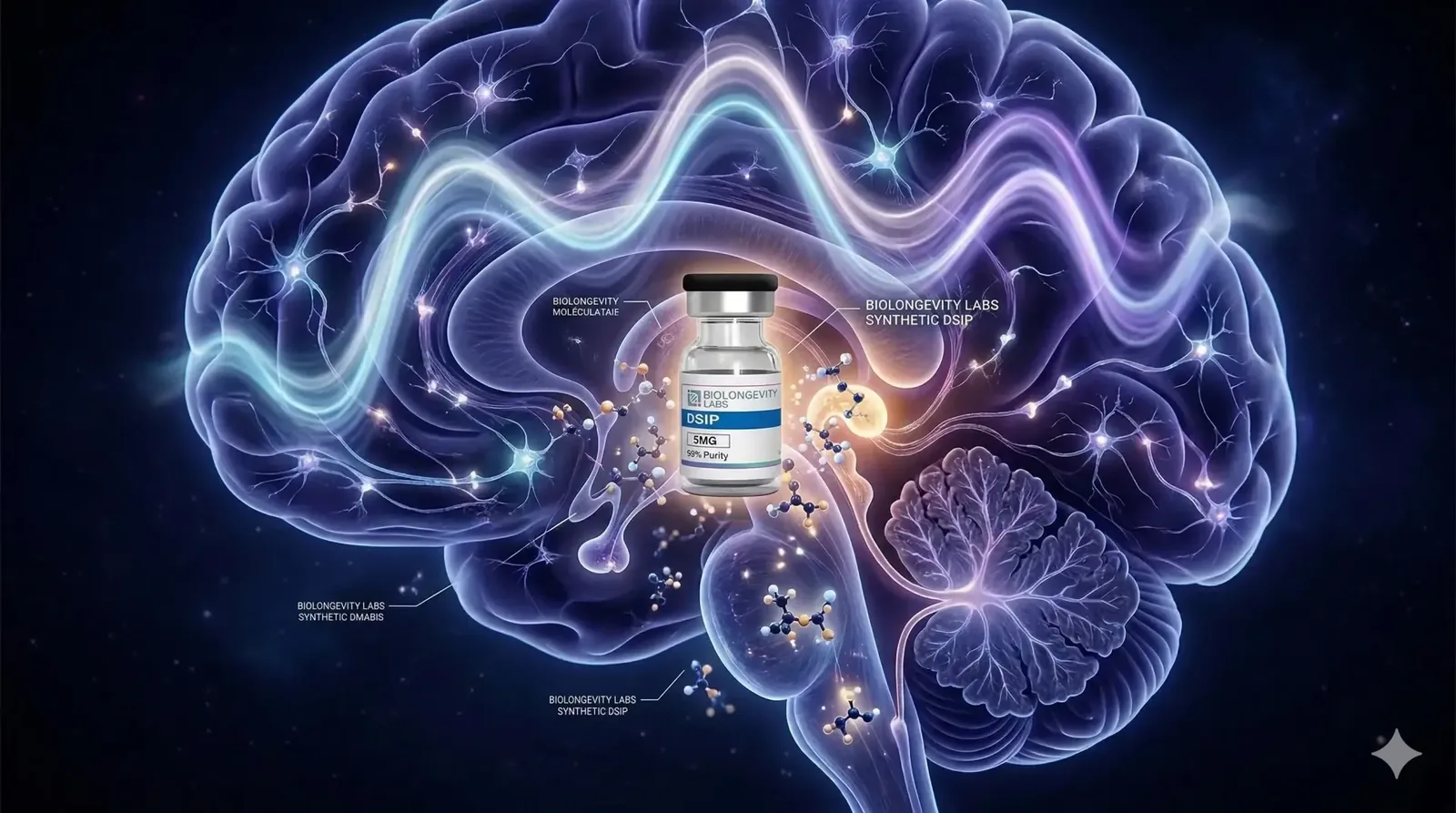
Biolongevity Labs lists DSIP in a 5mg vial. Orders it there for 15% off at checkout with PROBIO15, the discount code for Biolongevity Labs which is exclusive to Project Biohacking.
Stacking DSIP for Sleep Optimization
Research-focused biohackers have explored DSIP within broader sleep stacks, though direct evidence supporting specific combinations is limited.
DSIP and magnesium glycinate represent perhaps the most conservative stack in this category. In a meta-analysis of three small trials in older adults, magnesium shortened time to fall asleep by about 17 minutes, though the evidence was rated low to very low quality (Mah and Pitre, 2021). Combining it with DSIP's proposed slow-wave enhancement creates a layered approach that addresses both sleep initiation and sleep depth without pharmacological overlap.
DSIP and GABAergic support through compounds such as L-theanine or low-dose ashwagandha follows a similar logic: reduce excitatory tone at sleep onset while the peptide targets the architecture of sleep itself.
The DSIP and Epitalon combination is the most advanced stack positioning in this category. Researchers who use it typically frame Epitalon as providing long-cycle circadian and pineal support while DSIP addresses acute sleep quality on nights when delta-wave sleep depth is the specific objective. This stack is not appropriate for beginners and assumes established familiarity with both compounds individually.
DSIP and Epitalon are both included in the Ascension Peptides catalog at 10mg. PROBIO20, from Project Biohacking, is the Ascension Peptides discount code, which is set to 20%.
Is DSIP the Best Peptide for Sleep and Energy?
The question implies a direct relationship between sleep and next-day energy that deserves unpacking. DSIP does not produce energy in any stimulatory sense. A rat study notes earlier suggestions that DSIP's anticonvulsant action works through dopaminergic, adrenergic, and GABAergic brain systems (Stanojlovic et al., 2001).
What DSIP may provide is the foundation from which energy becomes possible: adequate deep sleep. In young healthy adults, suppressing slow-wave sleep through the night, without changing total sleep time, markedly reduced insulin sensitivity (Tasali et al., 2008). A compound that reliably extends delta-wave sleep duration could produce measurable next-day performance improvements without any direct stimulatory mechanism.
For experienced biohackers using the peptide calculator to structure their research protocols, DSIP fits most logically into a sleep-optimization cluster rather than a performance-enhancement stack. The distinction matters when sequencing compounds and evaluating downstream effects.
Whether DSIP is the best sleep peptide depends on what specifically is being targeted. For slow-wave sleep depth, its name promises the most, but controlled human trials did not show DSIP increasing slow-wave sleep (Monti et al., 1987) or lowering cortisol (Späth-Schwalbe et al., 1995). For circadian timing, melatonin remains more targeted. For anxiety-driven insomnia, Selank may be more appropriate.
Risks, Limitations, and What the Research Actually Shows
DSIP's research profile has a fundamental constraint: the quality and volume of human evidence is limited. The foundational human studies date from the 1980s and involved small sample sizes, variable methodologies, and intravenous administration that limits applicability to current subcutaneous research protocols.
Response variability is substantial. In one small study, the response was larger in more severely disturbed sleepers (Schneider-Helmert, 1986). This suggests DSIP may function more as a correction mechanism than as a sleep enhancer for individuals with intact sleep function.
The regulatory environment for research peptides is evolving. Sourcing quality directly affects experimental outcomes, and third-party testing documentation is a minimum standard for any serious researcher. Understanding what testing actually reveals about peptide quality is addressed in detail in the guide to third-party testing standards.
DSIP has no approved human applications and no established safety profile derived from controlled long-term human studies. Researchers should treat all available data as preliminary and frame their interest accordingly.
---
Building a sleep protocol around DSIP requires more than sourcing the compound. It requires a clear framework for evaluating response, adjusting timing, and understanding when the data you are collecting actually means something. Current verified discount codes for every company we track are on one page.
DSIP AI Overview FAQ
What peptide helps sleep the most?
In one trial, DSIP increased total sleep time through stage 2 sleep, while slow-wave sleep was not modified. It differs from melatonin, which signals circadian timing, by targeting the architecture of sleep itself, particularly delta-wave sleep depth and HPA axis modulation.
What is DSIP peptide used for?
DSIP is used in research contexts to evaluate its effects on delta-wave sleep induction, sleep latency reduction, cortisol attenuation under stress, and circadian rhythm support. It has no approved clinical applications and is available for research purposes only.
How does DSIP improve sleep quality?
DSIP is proposed to reduce excitatory neuronal activity in wake-promoting circuits, attenuate cortisol secretion that disrupts slow-wave sleep initiation, and support the neurological conditions that precede delta-wave sleep. Human data supporting these mechanisms remains limited and derived primarily from small studies.
What is the research dosage of DSIP for sleep?
Sleep studies in patients gave DSIP intravenously at 25 or 30 nmol per kilogram of body weight. This is research-protocol information only and does not constitute dosing guidance.
Is DSIP better than melatonin for sleep?
They address different aspects of sleep. Melatonin regulates circadian timing and signals darkness onset. DSIP is proposed to extend slow-wave sleep duration and depth. Researchers exploring sleep architecture rather than sleep timing may find DSIP more relevant, though the evidence base for DSIP is substantially smaller.
Can DSIP improve energy levels?
DSIP has no stimulatory mechanism and does not directly affect energy systems. Its proposed connection to next-day performance is indirect: by extending restorative delta-wave sleep, it may support the physical and cognitive recovery processes that adequate slow-wave sleep enables. The effect is downstream of sleep quality, not a direct action of the peptide itself.
About the Author
Jeff Nunn is the founder of Project Biohacking. With over 30 years of biohacking practice, he applies decades of self-experimentation methodology to peptide research, dosing math, and vendor evaluation.
Important Disclaimer: The content on Project Biohacking is for educational and informational purposes only and is not intended as medical advice, diagnosis, or treatment. Always consult a qualified healthcare professional before making any changes to your health regimen, starting new supplements, peptides, or protocols. Nothing on this site establishes a doctor-patient relationship, and you use the information at your own risk. Research compounds discussed here are sold for laboratory research purposes only and are not approved for human or veterinary use or consumption.