CJC-1295 and Ipamorelin Stack: Dosage, Benefits and Side Effects

By Jeff NunnPublished · 16 min read
The CJC-1295 and ipamorelin stack pairs two peptides that make the pituitary gland release growth hormone through two different receptors.
The key facts, in brief:
- What it is: CJC-1295, a lab-made version of GHRH (growth hormone-releasing hormone), paired with ipamorelin, which acts on the ghrelin receptor.[1][4]
- Why they are paired: in people, GHRH and an older secretagogue (GHRP-6) given together released more growth hormone than the sum of each given alone.[5] Ipamorelin and CJC-1295 were not part of that test.
- Human data: every published CJC-1295 study in people used the long-acting DAC form, not the No DAC form sold in most blends.[8]
- Typical clinic protocol: clinics commonly use 100 to 200 mcg of CJC-1295 without DAC in each injection, given with ipamorelin at night on an empty stomach.
- Regulators: neither peptide has approval from the U.S. Food and Drug Administration (FDA). In 2024 the agency's compounding advisers voted down both, and anti-doping rules prohibit both for competing athletes.[8][9][10][14]
What Is the CJC-1295 and Ipamorelin Stack?
The stack is two peptides injected together, usually from one vial. Each one prompts the pituitary to put out more of the body's own growth hormone. Neither one is growth hormone.
CJC-1295 is a modified copy of GHRH, the signal the hypothalamus sends to the pituitary. It comes in two forms. CJC-1295 with DAC (drug affinity complex) attaches to the blood protein albumin, which keeps it active for days. In healthy adults its half-life was 5.8 to 8.1 days.[1] The short-acting version, CJC-1295 without DAC (also sold as Mod GRF 1-29), is the one in most blends. Our CJC-1295 DAC vs No DAC comparison covers the difference in detail.
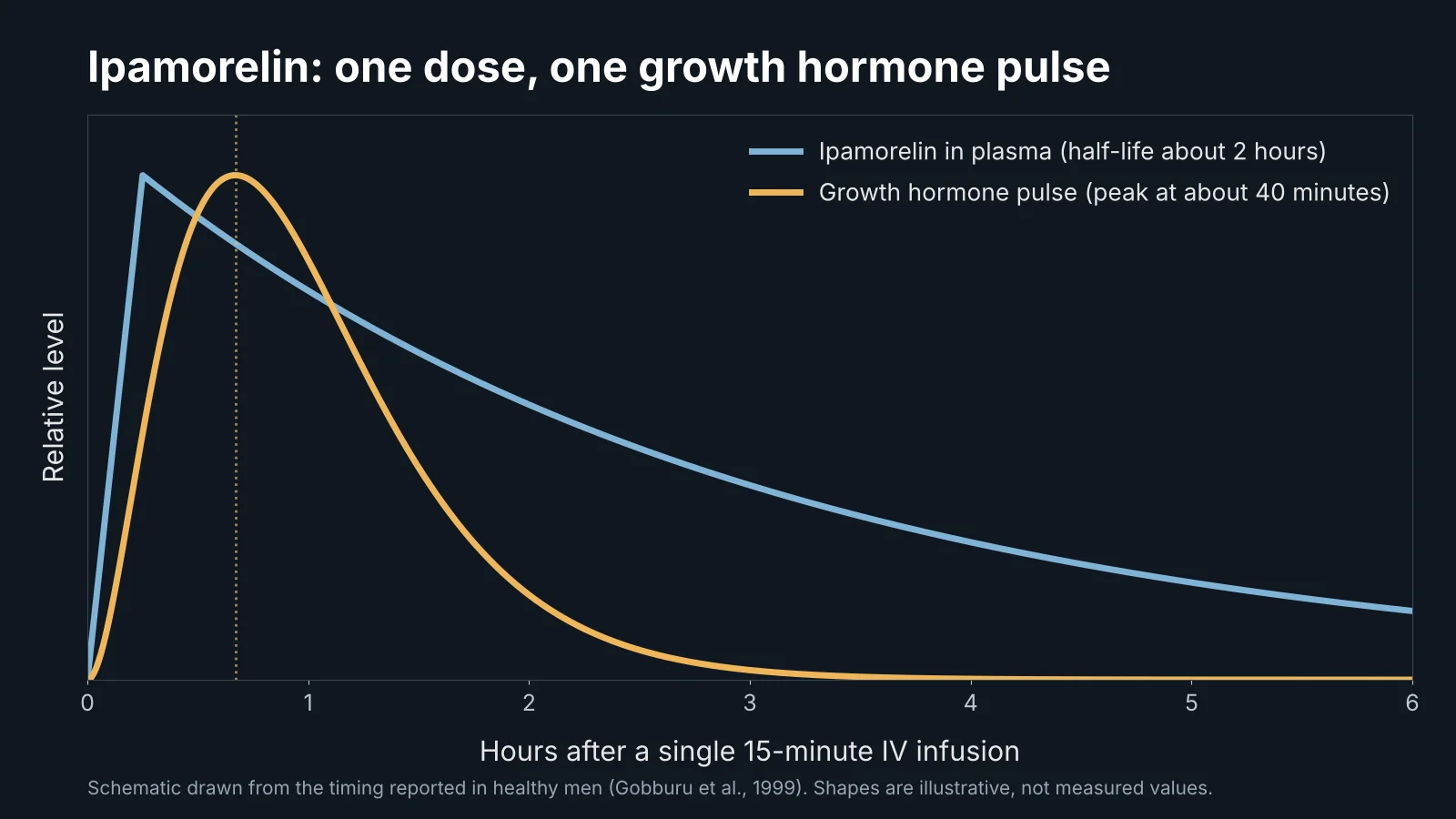
Ipamorelin, developed at Novo Nordisk, is a peptide only five amino acids long. Its target is the receptor the body normally uses for the hunger hormone ghrelin; the receptor's formal name is the growth hormone secretagogue receptor.[4] Given by vein to healthy men, it produced a single growth hormone peak roughly 40 minutes later, and half the dose was gone in about 2 hours.[3] Our ipamorelin peptide guide covers the rest of its profile.
One fact changes how to read every CJC-1295 claim. In its 2024 review, the FDA located only three studies of CJC-1295 in people, and all three gave the DAC form to healthy subjects.[8] The No DAC form remains essentially uncharacterized in peer-reviewed human studies [13].
Why CJC-1295 and Ipamorelin Are Taken Together
The case for the stack rests on receptors. CJC-1295 works on the GHRH receptor. Ipamorelin works on a growth hormone-releasing peptide (GHRP) type receptor, as shown in rat pituitary cells.[4] Two different signals reach the same gland at the same time.
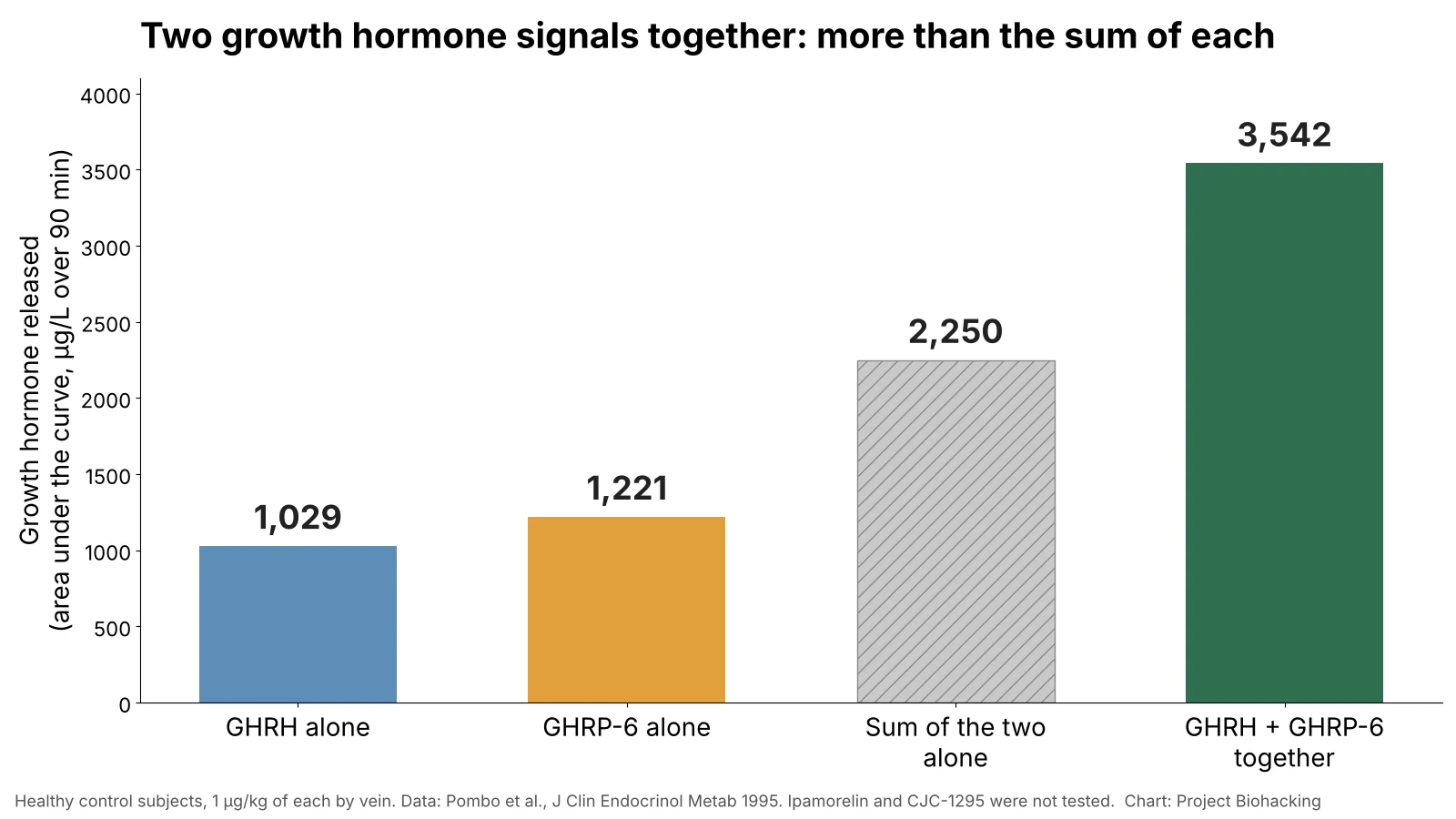
The best human evidence for combining the two signals comes from older peptides. In a 1995 study, healthy control subjects received GHRH, GHRP-6 or both by vein at 1 mcg/kg each.[5] Growth hormone released over 90 minutes (area under the curve) was:
- 1,029 after GHRH alone
- 1,221 after GHRP-6 alone
- 3,542 after both together, significantly higher than either alone
The pair released more than the 2,250 total of the two given separately. That is true synergy, not just addition. A 1993 study saw the same effect with GHRP-1 and GHRH given together as an intravenous bolus.[6] A 1997 review summed it up: the growth hormone-releasing activity of GHRPs "is synergistic with that of GHRH."[7]
Now the limits. Those tests used natural GHRH and GHRP-6, single doses, given into a vein in a clinic. They did not use CJC-1295 or ipamorelin, and they did not run for weeks. The FDA noted that several websites recommend CJC-1295 with ipamorelin on the claim that the two "work synergistically," and its review cited no controlled data on the combination.[8]
The same 1997 review adds a detail worth knowing. GHRP effects undergo partial desensitization, more during continuous infusion and less during intermittent dosing.[7] Clinics give the stack as one injection a day, though no study has tested whether that schedule matters for this pair.
CJC-1295 and Ipamorelin Dosage
There is no tested dose for the blend. This section gives the doses studies used for each peptide alone, then the doses clinics use for the stack.
CJC-1295 and Ipamorelin Doses in Published Research
| Study | Who | Peptide, route and dose | Length | What it showed |
|---|---|---|---|---|
| Teichman 2006 [1] | Healthy adults, ages 21 to 61 | CJC-1295 with DAC under the skin, four rising single doses, then 2 or 3 repeat doses spaced a week or two apart | 28 and 49 days | Growth hormone rose 2- to 10-fold and stayed up 6 days or longer; IGF-1 (insulin-like growth factor 1) rose 1.5- to 3-fold and stayed up 9 to 11 days; 30 and 60 mcg/kg were tolerated best |
| Ionescu 2006 [2] | Healthy men, ages 20 to 40 | CJC-1295 with DAC under the skin, 60 or 90 mcg/kg once | 1 week | Trough growth hormone up 7.5-fold, mean growth hormone up 46%, IGF-1 up 45%; pulses preserved |
| Gobburu 1999 [3] | Healthy men, 8 at each dose | Ipamorelin infused by vein for 15 minutes, doses from 4.21 up to 140.45 nmol/kg | Single dose | A single growth hormone peak about 40 minutes in; half cleared in about 2 hours |
| Pombo 1995 [5] | Healthy control subjects | GHRH plus GHRP-6 by vein, 1 mcg/kg each | Single dose | Growth hormone release more than the sum of each alone |
Scaled to someone weighing 80 kg, Teichman's 30 and 60 mcg/kg doses equal 2.4 and 4.8 mg of the DAC form per shot. Each was a single injection that acted for a week or more, not a daily dose. It does not translate to the daily No DAC injections people use.
Common Clinic CJC-1295 and Ipamorelin Dosage
Clinics commonly use 100 to 200 mcg of CJC-1295 without DAC in each injection, given with ipamorelin in the same injection. Clinics commonly give it at night, at least 2 hours after the last meal. Clinics commonly use 5 nights on and 2 nights off. Clinics commonly run cycles of 8 to 12 weeks, followed by a break of at least 4 weeks.
Clinics commonly use the No DAC form of CJC-1295 with ipamorelin. For ipamorelin's own dose range, see our ipamorelin dosage guide.
CJC-1295 Ipamorelin Dosage Per Day
Clinics commonly give the blend as one injection at night.
Blend Vial Math: Units and How Long a Vial Lasts
Blend vials most often contain 10 mg, split evenly between the two peptides. Add 2 mL of bacteriostatic water and the solution carries 2.5 mg per mL of each peptide.
At 2 mL, the vial contains 200 units in all. A different volume of water changes what each unit delivers, so run your own numbers through the CJC-1295 ipamorelin dosage calculator before you mix.
For the step-by-step method, see how peptide concentration works, and check the basics of bacteriostatic water for peptides before reconstituting.
CJC-1295 No DAC or With DAC in the Stack?
Most blends use No DAC because its short action fits a single nightly pulse alongside ipamorelin. The DAC form keeps the GHRH signal on for days. In healthy men it raised trough growth hormone 7.5-fold while normal pulses continued.[2]
That steady signal is the opposite of the pulse-and-rest pattern most clinics aim for. It also has the only human safety data, since every published CJC-1295 trial used the DAC form.[8]
CJC-1295 and Ipamorelin Benefits: Measured vs Assumed
Claims for the stack borrow the claims made for growth hormone itself, from more muscle and less fat to better sleep, recovery and skin. Below, each claim is sorted by whether anyone has measured it.
Hormone levels in humans. Measured, but only one peptide at a time. In healthy adults the DAC form of CJC-1295 kept IGF-1 and growth hormone elevated for days.[1][2] In healthy men, each intravenous dose of ipamorelin tried produced a growth hormone release.[3]
More growth hormone from two signals. Measured for GHRH plus GHRP-6, not for this pair.[5]
Muscle, fat loss, recovery and sleep. Not measured for the stack. The CJC-1295 trials tracked hormone levels, pharmacokinetics and short-term safety.[1]
Weight. The only animal finding runs the wrong way for fat loss. Mice given ipamorelin twice a day gained about 15% in body weight; their fat stores grew and they ate more.[11]
Published in 2026, a Frontiers in Endocrinology paper named both forms of CJC-1295, plus ipamorelin, as peptides people dose themselves from online protocols [13]. Its authors graded the evidence on a scale running from trials fit for regulators to compounds never studied in humans, and judged the claimed gains in performance and body composition uncertain.[13]
How Long Does CJC-1295 and Ipamorelin Take to Work?
No trial has timed results for the stack.
CJC-1295 and Ipamorelin Safety and Side Effects
Neither CJC-1295 trial in healthy volunteers reported a serious adverse reaction [1]. The drug was described as safe and relatively well tolerated, particularly at 30 or 60 mcg/kg.[1] Those trials lasted 28 and 49 days [1][2].
The FDA reads the record more cautiously. Its list of bulk substances it considers risky for compounding names these concerns for CJC-1295:[12]
- Immune reactions. Compounded CJC-1295 may pose a risk of immunogenicity for certain routes of administration.
- Hard to test. It may have peptide-related impurities and be hard to characterize.
- Serious adverse events. The FDA placed CJC-1295 in Category 2 of its bulk drug substances list because of reports of vasodilatory reactions and tachycardia [13].
- Little data. Controlled clinical evidence that the combination improves body composition in healthy people remains limited [13].
Ipamorelin acetate is on the same list. The FDA cites possible immune reactions, unnatural amino acids in its structure, and a case report in the literature describing serious adverse events, one of them fatal, when intravenous ipamorelin was tried for gut motility.[12]
The FDA's 2024 review also notes that ConjuChem withdrew CJC-1295 DAC from clinical trials in 2006 after the death of a subject in a phase 2 trial.[8] The review did not say the drug caused the death.
What Clinicians See in Self-Injectors
That same 2026 paper sorted the complications doctors report in people who inject these peptides without supervision into four groups:[13]
- Endocrine and metabolic effects, such as higher prolactin and cortisol, shifts in appetite, and blood sugar outside the normal range
- Fluid retention
- Muscle and joint aches
- Injection-site reactions
Long-Term Side Effects
Unknown. The longest CJC-1295 trial ran 49 days, and no study has followed the stack for months or years.[1] The FDA found no studies of any form of CJC-1295 in people with a disease or condition.[8]
Is the CJC-1295 and Ipamorelin Blend Legal?
The FDA has approved neither peptide for any use.
Five CJC-1295 substances came before the agency's Pharmacy Compounding Advisory Committee on December 4, 2024 [18]. Members rejected CJC-1295 free base and each DAC version 0 to 13, and CJC-1295 acetate 1 to 12.[9] Ipamorelin acetate had been rejected about five weeks earlier, on October 29, 2024, by 12 votes to none with one member abstaining.[10]
The FDA's risk list placed ipamorelin acetate in Category 2 for outsourcing facilities on September 29, 2023, while CJC-1295 appears in its table of withdrawn nominations.[12] Both are caught up in the legal dispute over peptide compounding, which we track in the FDA peptide fight. For how the rules apply to a prescription versus a vial labeled "research use only," read how compounding pharmacy peptides are regulated.
Sport is clearer still. According to the FDA's briefing, World Anti-Doping Agency rules ban growth hormone secretagogues, CJC-1295 among them, both in and out of competition.[8] Ipamorelin falls under section S2.4 of that list.[14]
CJC-1295 and Ipamorelin vs Tesamorelin and Sermorelin
CJC-1295, tesamorelin and sermorelin all copy GHRH and work on the same receptor. Ipamorelin is the odd one out, working on the ghrelin receptor.
| Peptide | Receptor | Human data | FDA status |
|---|---|---|---|
| CJC-1295 with DAC | GHRH | Short trials in healthy adults [1][2] | Not approved |
| CJC-1295 No DAC | GHRH | None found by the FDA [8] | Not approved |
| Ipamorelin | Ghrelin (secretagogue) | Intravenous studies only [3] | Not approved |
| Tesamorelin | GHRH | Two phase 3 trials [15] | Approved for HIV-associated lipodystrophy |
| Sermorelin | GHRH | Listed with CJC-1295 in the 2026 review [13] | Not approved for these uses |
Tesamorelin is a growth hormone releasing factor analogue that the FDA approved in November 2010 for lipodystrophy associated with HIV infection [15]. It was approved in November 2010 for lipodystrophy associated with HIV infection, after two phase 3 trials showed less visceral fat over 26 weeks.[15] Our tesamorelin guide covers it in full.
Pairing CJC-1295 with sermorelin hits the GHRH receptor twice instead of opening a second route, and that combination has never been studied either. Our comparison of peptides for hormone balance puts all of them in context.
Checking What Is in the Vial
All of the dosing math here depends on the vial containing what its label claims, and a blend doubles what has to be verified. Look for a certificate of analysis that confirms the identity and quantity of each peptide separately. What matters in third-party testing explains how to read one, and our directory of research peptide suppliers gathers the vendors we follow.
BioEdge Research Labs offers the CJC 1295 No Dac + Ipamorelin blend as a 10 mg vial (5 mg of each) or a 20 mg vial (10 mg of each). Its listing states HPLC purity of 99% or more, and the lab results sit under the 3rd Party Testing heading beneath the product photo. Our BioEdge coupon code, PROBIO15, lowers the order total by 15 percent.
CJC-1295 and Ipamorelin FAQ
What is the dosing protocol for CJC-1295 and ipamorelin?
There is no trial-tested dose for the combination. Clinics commonly use 100 to 200 mcg of CJC-1295 without DAC in each injection, given with ipamorelin at night.
Why are CJC-1295 and ipamorelin taken together?
They use two different receptors on the pituitary gland. In a 1995 study, GHRH and GHRP-6 given together produced a growth hormone response of 3,542, more than the 1,029 and 1,221 from each alone [5]. That study tested GHRH and GHRP-6 given intravenously [5]. CJC-1295 and ipamorelin have never been tested together.
How long does a 10 mg CJC-1295 and ipamorelin vial last?
Reconstituted with 2 mL of bacteriostatic water, a vial holding 5 mg of each peptide gives 200 units.
Should the blend use CJC-1295 with DAC or No DAC?
Most blends use No DAC, which acts briefly and fits a single nightly pulse. The DAC form keeps the signal on for days and raised trough growth hormone 7.5-fold in healthy men. The best human evidence for CJC-1295 comes from trials of the DAC form, while the No DAC form remains essentially uncharacterized in peer-reviewed human studies [13].
Does CJC-1295 and ipamorelin make you lose weight?
No evidence says it does. In mice, ipamorelin on its own pushed body weight up about 15%, and the animals stored extra fat and ate more.
Does CJC-1295 raise testosterone?
Not as far as anyone has measured. The CJC-1295 trials tracked growth hormone (up 2- to 10-fold) and IGF-1 (up 1.5- to 3-fold) in healthy adults, and testosterone was not an outcome [1]. We found no human data linking CJC-1295 to testosterone.
What are the side effects of CJC-1295 and ipamorelin?
The CJC-1295 trials reported no serious adverse reactions over 28 and 49 days [1][2]. The FDA cited reports of tachycardia and vasodilatory reactions when it placed CJC-1295 in Category 2 [13]. Clinicians also see fluid retention, joint aches, injection-site reactions and blood sugar changes in people using growth hormone peptides. Long-term effects are unknown.
References
- Teichman SL, Neale A, Lawrence B, et al. Prolonged stimulation of growth hormone (GH) and insulin-like growth factor I secretion by CJC-1295, a long-acting analog of GH-releasing hormone, in healthy adults. J Clin Endocrinol Metab. 2006;91(3):799-805. doi:10.1210/jc.2005-1536
- Ionescu M, Frohman LA. Pulsatile secretion of growth hormone (GH) persists during continuous stimulation by CJC-1295, a long-acting GH-releasing hormone analog. J Clin Endocrinol Metab. 2006;91(12):4792-7. doi:10.1210/jc.2006-1702
- Gobburu JV, Agersø H, Jusko WJ, Ynddal L. Pharmacokinetic-pharmacodynamic modeling of ipamorelin, a growth hormone releasing peptide, in human volunteers. Pharm Res. 1999;16(9):1412-6. doi:10.1023/a:1018955126402
- Raun K, Hansen BS, Johansen NL, et al. Ipamorelin, the first selective growth hormone secretagogue. Eur J Endocrinol. 1998;139(5):552-61. doi:10.1530/eje.0.1390552
- Pombo M, Barreiro J, Peñalva A, et al. Absence of growth hormone (GH) secretion after the administration of either GH-releasing hormone (GHRH), GH-releasing peptide (GHRP-6), or GHRH plus GHRP-6 in children with neonatal pituitary stalk transection. J Clin Endocrinol Metab. 1995;80(11):3180-4. doi:10.1210/jcem.80.11.7593423
- Bowers CY. GH releasing peptides: structure and kinetics. J Pediatr Endocrinol. 1993;6(1):21-31. doi:10.1515/jpem.1993.6.1.21
- Ghigo E, Arvat E, Muccioli G, Camanni F. Growth hormone-releasing peptides. Eur J Endocrinol. 1997;136(5):445-60. doi:10.1530/eje.0.1360445
- U.S. Food and Drug Administration. FDA evaluation of CJC-1295 related bulk drug substances, briefing for the Pharmacy Compounding Advisory Committee, December 4, 2024. November 15, 2024.
- U.S. Food and Drug Administration. Pharmacy Compounding Advisory Committee, December 4, 2024: meeting minutes. 2024.
- U.S. Food and Drug Administration. Pharmacy Compounding Advisory Committee, October 29, 2024: meeting minutes. 2024.
- Lall S, Tung LY, Ohlsson C, Jansson JO, Dickson SL. Growth hormone (GH)-independent stimulation of adiposity by GH secretagogues. Biochem Biophys Res Commun. 2001;280(1):132-8. doi:10.1006/bbrc.2000.4065
- U.S. Food and Drug Administration. Certain bulk drug substances for use in compounding that may present significant safety risks. Content current as of April 22, 2026.
- Dominikowski A, Rękoś Z, Olejarz M, et al. The emerging landscape of performance-enhancing peptides modulating GH-IGF1 axis: bridging the gap between clinical evidence and patient self-administration. Front Endocrinol (Lausanne). 2026;17:1822475. doi:10.3389/fendo.2026.1822475
- U.S. Food and Drug Administration. Pharmacy Compounding Advisory Committee, October 29, 2024: briefing document on ipamorelin. 2024.
- Spooner LM, Olin JL. Tesamorelin: a growth hormone-releasing factor analogue for HIV-associated lipodystrophy. Ann Pharmacother. 2012;46(2):240-7. doi:10.1345/aph.1Q629
- A4PC: PCAC votes against four nominated bulk drug substances
- Analysis of growth hormone releasing hormone and its analogs in urine using nano liquid chromatography coupled with quadrupole/orbitrap mass spectrometry
- U.S. Food and Drug Administration. Pharmacy Compounding Advisory Committee; Notice of Meeting. Federal Register, October 25, 2024.
About the Author
Jeff Nunn is the founder of Project Biohacking. With over 30 years of biohacking practice, he applies decades of self-experimentation methodology to peptide research, dosing math, and vendor evaluation.
Important Disclaimer: The content on Project Biohacking is for educational and informational purposes only and is not intended as medical advice, diagnosis, or treatment. Always consult a qualified healthcare professional before making any changes to your health regimen, starting new supplements, peptides, or protocols. Nothing on this site establishes a doctor-patient relationship, and you use the information at your own risk. Research compounds discussed here are sold for laboratory research purposes only and are not approved for human or veterinary use or consumption.