Wolverine Protocol: BPC-157 + TB-500 Stack for Accelerated Tissue Repair

By Jeff NunnPublished · Updated · 15 min read

The Science Behind the Most Popular Peptide Recovery Stack in Biohacking
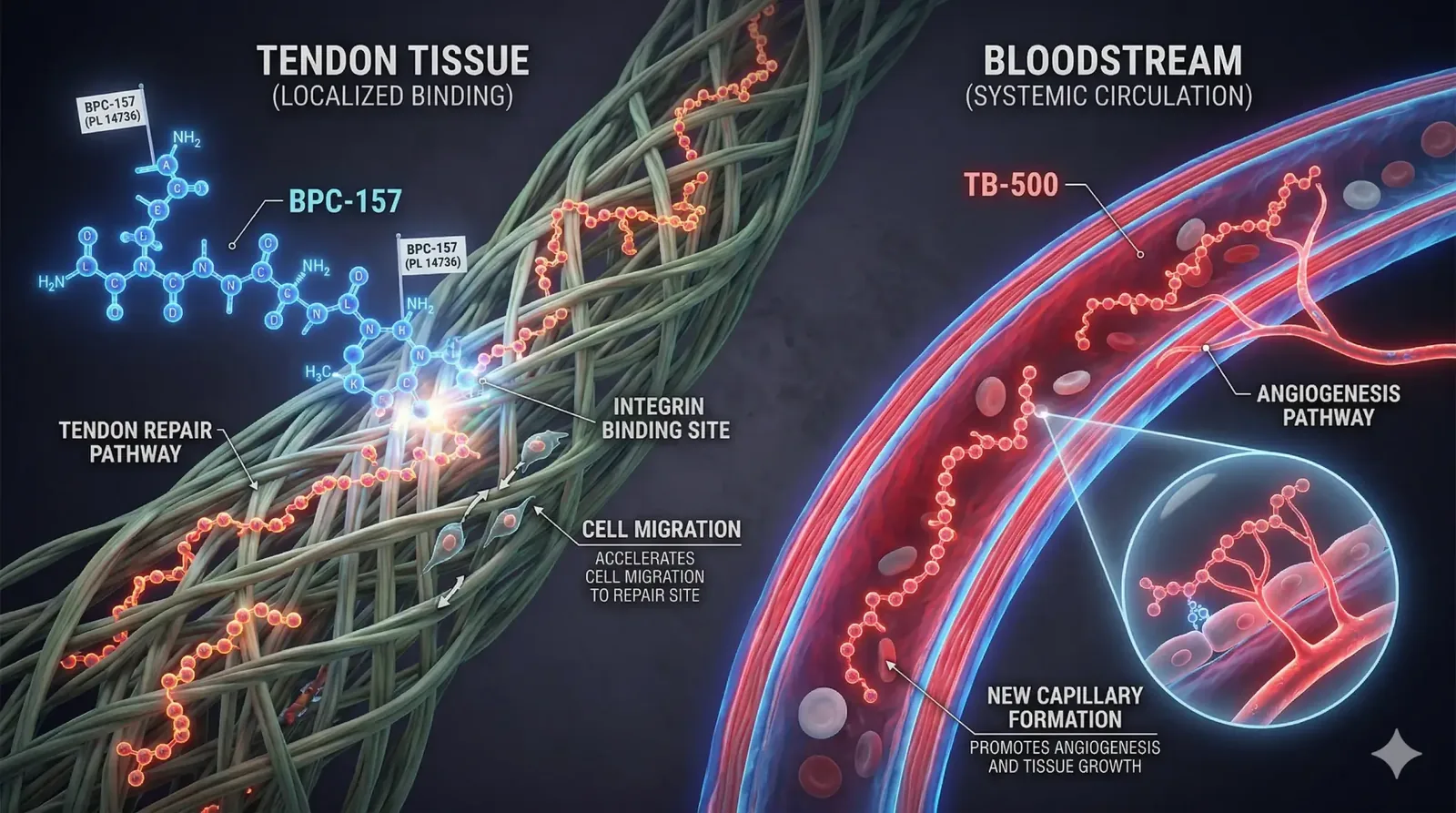
The Wolverine Protocol has become one of the most recognized peptide stacks in the biohacking and performance recovery space. Named after the fictional mutant with near-instant healing, the protocol pairs two research peptides, BPC-157 and TB-500, that have been studied mostly in rats for tissue repair.[1] The stack is built on the idea that combining the two works better than either alone, but the one rat tendon study that tested this found no added benefit.[2] Some researchers extend that same logic to a third compound, adding GHK-Cu for matrix remodeling, in our guide to the GHK-Cu, TB-500, and BPC-157 GLOW blend.
This guide covers the science behind the protocol, how each peptide functions, how the stack is structured in research contexts, and what the available evidence suggests about safety and limitations.
What Is the Wolverine Protocol
The Wolverine Protocol is a research peptide stack combining BPC-157 (Body Protection Compound-157) and TB-500, a synthetic version of the active region of thymosin beta-4.[3] Each peptide showed its own mechanisms in animal models, mostly rats, but those benefits remain unproven in human trials.[1]
The name is informal. It originated in biohacking and performance communities where the protocol's reputation for supporting accelerated tissue repair led researchers and self-experimenters to draw a loose analogy to Wolverine's regenerative biology in Marvel comics. The name stuck, and it now functions as shorthand for this specific two-peptide stack.
The protocol is studied mainly in animal models of tendon, muscle, bone and ligament injury.[1] BPC-157 is not approved for human use, and evidence for it is largely limited to animal models.[4]
Evaluating the Wolverine Protocol? Verify third-party testing and COAs before sourcing compounds.
How the Wolverine Protocol Works
Each peptide has its own proposed mechanism, based mostly on rat studies.[1] BPC-157 is a pentadecapeptide derived from human gastric juice.[5] In rat and lab studies, it increased new blood vessel growth (angiogenesis) and raised levels of VEGFR2, a growth factor receptor.[6] In animal studies, BPC-157 has shown possible benefits for tendon and muscle repair, but these findings are largely unconfirmed in human trials.[7]
TB-500 is a synthetic version of the LKKTETQ segment of thymosin beta-4, the part of that natural protein responsible for actin binding, cell migration and wound healing.[3] Thymosin beta-4 is the main actin-sequestering molecule in cells.[8] TB-500 promoted tissue repair in preclinical models, but human orthopedic data are lacking.[7]
The two peptides are thought to target healing from different entry points, but in a rat Achilles tendon study, combined treatment did not confer additional benefits over either agent alone.[2] The authors said both may converge on shared downstream pathways, a hypothesis that needs further testing.[2]
BPC-157 and TB-500 Explained
BPC-157 and TB-500 are distinct peptides with different structures, origins, and primary research applications. Understanding each individually clarifies why the Wolverine stack is designed the way it is.
BPC-157
BPC-157 is a 15-amino acid peptide derived from human gastric juice.[5] In preclinical models, BPC-157 improved functional, structural and biomechanical outcomes in muscle, tendon, ligament and bone injuries.[9] Of 36 studies in a 2025 systematic review, 35 were preclinical.[9] Our review of BPC-157 benefits takes those findings one at a time, from tendon and gut repair to the few human reports.
In a rat tendon-to-bone injury study, it led to better-organized collagen fibers and a more advanced blood vessel appearance at the repair site.[10] In rats with a cut knee ligament (MCL), BPC-157 led to functional, biomechanical and tissue-level healing improvements.[11]
TB-500
TB-500 is a synthetic version of the active region of thymosin beta-4.[3] In a rat full thickness wound model, thymosin beta-4 increased reepithelialization, and treated wounds showed more collagen deposition and angiogenesis.[12]
TB-500 is sometimes called the protocol's "whole body" component, but TB-4 and TB-500 have promoted angiogenesis and tissue repair only in preclinical models, and human orthopedic data are lacking.[7] For a full breakdown of how TB-500 works at the cellular level, see our dedicated TB-500 healing peptide guide.
In a rat Achilles tendon study, TB-500 significantly improved tendon tissue scores and load to failure, while BPC-157's gains on both measures did not reach statistical significance.[2]
Wolverine Protocol Stack Structure
Information on dosing, frequency and duration of treatment for these peptides remains unknown, so no human dose or schedule has been established.[7]
The one rat study that compared the pair with each peptide alone found no added benefit from combining them.[2]
No study has established a human schedule for this stack, for acute injury or otherwise.[7]
Wolverine Protocol Dosage and Cycle
Studies of these peptides, mostly in animals, have used widely varying doses and routes.[1] No human dose or schedule has been established.[7]
Calculating appropriate research amounts based on bodyweight and target concentration requires attention to reconstitution variables. The main peptide calculator takes body weight or a fixed dose along with the vial size and water volume, and returns the units to draw.
Subscribe to the Project Biohacking newsletter for ongoing Wolverine Protocol research updates, stack analysis, and vendor review coverage.
How to Mix Wolverine Peptides (BPC-157 and TB-500)
Reconstituting peptides is a required step before any research use of the Wolverine Protocol. Both BPC-157 and TB-500 are supplied as lyophilized powders, meaning they must be mixed with a sterile solvent to create a usable solution. The most commonly used solvent in research settings is bacteriostatic water due to its ability to inhibit bacterial growth after reconstitution.
The mixing process begins by determining the desired concentration. This is calculated based on the amount of peptide in the vial and the volume of bacteriostatic water added. For example, adding 2 mL of bacteriostatic water to a 5 mg vial creates a different concentration than adding 5 mL. For a BPC-157 vial, the BPC-157 mixing and dosage calculator shows the concentration each water volume produces, the units to draw, and how many doses the vial holds. Precision at this stage is critical because all subsequent dosing calculations depend on the accuracy of the initial mixture.
To reconstitute, bacteriostatic water is drawn into a sterile syringe and slowly introduced into the peptide vial. The water should be allowed to run down the side of the vial rather than injected directly onto the powder. This reduces the risk of damaging the peptide structure. The vial is then gently swirled, not shaken, until the powder fully dissolves into a clear solution.
Each peptide in the Wolverine Protocol is typically reconstituted in its own vial rather than combined, so each vial carries its own concentration; the single-vial TB-500 dosage calculator turns the TB-500 vial's milligrams and water volume into a draw in syringe units. When a supplier ships the two peptides pre-combined in one vial, a single draw carries both, and the BPC-157 and TB-500 blend calculator shows the dose of each compound that draw delivers. This allows for more precise control over concentration, stability, and handling. Once reconstituted, the peptides are stored under refrigeration to maintain stability over time.
Because dosing calculations depend entirely on how the peptide is mixed, errors at this stage can compound throughout the protocol. Using a structured tool like the Project Biohacking Peptide Calculator helps ensure consistency between intended and actual concentrations.
Routes Used in the Research
The published research on these peptides shows significant heterogeneity in dosing and route of administration.[1]
Human BPC-157 studies have used knee injections, bladder instillation and intravenous infusion, and the overall certainty of their evidence was rated very low.[4]
Benefits of the Wolverine Protocol
Research on BPC-157 and TB-500, mostly in rats, has reported promising but variable effects in tendon, muscle, bone and ligament injury models.[1] These outcomes come mostly from animal studies, and the few human studies were small and mostly lacked proper controls.[1]
Injury recovery: Animal studies, mostly in rats, have reported promising but variable effects of both peptides on tendon, muscle, bone and ligament healing.[1]
Wound healing: A review of rat studies reports that BPC-157 sped healing of skin wounds and several other wound types.[13]
Reduced inflammation: In mice given a high dose of bacterial endotoxin, thymosin beta-4, the parent protein of TB-500, lowered death rates and blood levels of several inflammatory cytokines.[14] Researchers exploring inflammation-focused recovery also study KPV, an alpha-MSH-derived tripeptide that reduced inflammation in two mouse models of colitis.[15] See the guide to the KPV peptide for inflammation and healing.
Improved mobility: In a rat tendon-to-bone injury study, BPC-157 improved walking function scores and the repaired tendon's mechanical strength.[10]
Performance recovery: Athletes and biohackers applying the Wolverine Protocol typically do so to accelerate return-to-training timelines following musculoskeletal injury. Animal findings are promising, but claimed benefits for recovery and performance remain unproven in human trials.[1] For a broader look at peptide options across different injury types and recovery scenarios, see the complete guide to peptides for injury recovery.
Wolverine Crisis Protocol (Acute Use Case)
For use right after an acute injury, the indications, dosing, frequency and duration of treatment for these peptides remain unknown.[7]
The Wolverine Crisis Protocol is not a separate compound stack. It is the same BPC-157 and TB-500 combination, and no human dose or schedule has been established for it.[7]
Risks, Safety, and Research Limitations
Both peptides lack robust safety data.[1] Preclinical safety studies of BPC-157 showed no adverse effects across several organ systems, but no clinical safety data were found.[9]
Three human studies of BPC-157, with 16, 12 and 2 participants and no control groups, reported no treatment-related adverse events.[4] The review that pooled them judged all three to be of poor methodological quality.[4]
BPC-157 lacks US Food and Drug Administration approval.[9] Adverse effects are possible from unregulated manufacturing, contamination or unknown clinical safety.[9] BPC-157 should not be used clinically in humans outside ethically approved, regulated, high-quality clinical trials.[4]
Sourcing matters here for a practical reason. Peptide purity, sterility and accurate concentration labeling are not guaranteed outside controlled research supply chains, and compounds that are improperly synthesized, stored or reconstituted introduce risk separate from the peptide's own profile. Limitless Biotech publishes per-batch third-party COAs covering both BPC-157 and TB-500, and what those certificates include is set out in our review of Limitless Biotech.
For guidance on evaluating vendor quality and understanding what third-party testing actually tells you about a peptide product, see Third-Party Testing: What Actually Matters.
Who Uses the Wolverine Protocol
The Wolverine Protocol sits at the intersection of several overlapping communities, each approaching the stack from a different framework.
Biohackers represent the largest documented user base. This group self-experiments with research peptides as part of a broader optimization practice and has produced the most accessible documentation on protocol structure, cycle length, and subjective outcome tracking. The biohacking community's willingness to self-report has created a substantial body of anecdotal data supplementing the formal research record.
Running the Wolverine Protocol cleanly requires a structured approach, the biohacking research protocol guide covers how to design a valid N=1 experiment around any peptide stack. To control misuse of TB-500 in equine sports, a racing laboratory developed a doping test that detected it in horses given a single dose.[3] See our guide to peptides for dogs. For the personal story behind how this stack was first tested at Project Biohacking, see our biohacking transformation story. Maintaining peptide potency requires proper storage; our peptide storage guide covers refrigeration, freeze-thaw cycles, and shelf life.
Athletes, particularly those in high-load sports involving repetitive strain injury, tendon stress, and recovery demands, have adopted the Wolverine Protocol as a non-pharmaceutical recovery tool. Its claimed benefits for sports recovery remain unproven in human trials.[1] Recovery is only one reason men reach for peptides. For the wider picture of how men use recovery peptides alongside growth hormone, sleep, and body composition, see that guide.
Individuals recovering from musculoskeletal injury outside of formal physical therapy have used the protocol to support recovery timelines. A 2026 scoping review said peptide supplements should not currently be recommended as a replacement or adjunct for standard orthopedic care.[1]
The research community continues to generate preclinical literature on both peptides individually. Clinical research involving human subjects at scale remains limited, which constrains how much formal scientific guidance exists on the combined protocol.[1]
At Biolongevity Labs the BPC-157 and TB-500 pairing comes premixed at 10mg, and each peptide is also sold alone at 10mg. Whichever you pick, the Biolongevity coupon code from Project Biohacking, PROBIO15, lowers the total by 15 percent.
Ascension Peptides pairs the two compounds in one product, listing BPC-157 10mg with TB-500 10mg as a 20mg item it calls the Wolverine Stack. It also lists BPC-157 at 10mg and TB-500 at 5mg individually. Ascension's checkout accepted PROBIO20, the Project Biohacking discount code for Ascension Peptides, on a Wolverine Stack order on October 1, 2026.
Other vendors carry BPC-157 and TB-500 separately rather than as a pre-mixed stack. They are listed with the rest of the research peptide companies we cover.
Wolverine Protocol FAQ
What is the Wolverine Protocol?
The Wolverine Protocol is a research peptide stack combining BPC-157 and TB-500. Peptides like these are marketed for faster recovery from musculoskeletal injury, but those benefits remain unproven in human trials.[1] The name is informal, derived from the regenerative biology of the fictional Marvel character.
How does the Wolverine peptide stack work?
What is the difference between BPC-157 and TB-500?
How long does the Wolverine Protocol take to work?
No human timeline has been established, since information on the duration of treatment remains unknown.[7]
What is a typical Wolverine Protocol cycle?
No human dose, cycle or schedule has been established for BPC-157 or TB-500.[7]
What are the risks of the Wolverine Protocol?
References
- Tewari K, Liu TP, Im C, et al. Peptide Supplements and Their Therapeutic Applications in Sports Medicine. Am J Sports Med. 2026:3635465261464420.
- Biçer O, Adanir O, Güleryüz Y, et al. Effects of BPC-157 and TB-500 on Achilles tendon healing in rats: A histopathological and biomechanical study. Jt Dis Relat Surg. 2026;37(3):822-837.
- Ho EN, Kwok WH, Lau MY, et al. Doping control analysis of TB-500, a synthetic version of an active region of thymosin β₄, in equine urine and plasma by liquid chromatography-mass spectrometry. J Chromatogr A. 2012;1265:57-69.
- Poolton JT, Minett J, Kazmi A. Human evidence for BPC-157 in orthopaedic and regenerative medicine: a systematic review of efficacy and safety. Acta Orthop Belg. 2026;92(3).
- Chang CH, Tsai WC, Hsu YH, et al. Pentadecapeptide BPC 157 enhances the growth hormone receptor expression in tendon fibroblasts. Molecules. 2014;19(11):19066-77.
- Hsieh MJ, Liu HT, Wang CN, et al. Therapeutic potential of pro-angiogenic BPC157 is associated with VEGFR2 activation and up-regulation. J Mol Med (Berl). 2016;95(3):323-333.
- Mayfield CK, Bolia IK, Feingold CL, et al. Injectable Peptide Therapy: A Primer for Orthopaedic and Sports Medicine Physicians. Am J Sports Med. 2026;54(1):223-229.
- Goldstein AL, Hannappel E, Kleinman HK. Thymosin beta4: actin-sequestering protein moonlights to repair injured tissues. Trends Mol Med. 2005;11(9):421-9.
- Vasireddi N, Hahamyan H, Salata MJ, et al. Emerging Use of BPC-157 in Orthopaedic Sports Medicine: A Systematic Review. HSS J. 2025;21(4):485-495.
- Krivic A, Anic T, Seiwerth S, et al. Achilles detachment in rat and stable gastric pentadecapeptide BPC 157: Promoted tendon-to-bone healing and opposed corticosteroid aggravation. J Orthop Res. 2006;24(5):982-9.
- Cerovecki T, Bojanic I, Brcic L, et al. Pentadecapeptide BPC 157 (PL 14736) improves ligament healing in the rat. J Orthop Res. 2010;28(9):1155-61.
- Malinda KM, Sidhu GS, Mani H, et al. Thymosin beta4 accelerates wound healing. J Invest Dermatol. 1999;113(3):364-8.
- Seiwerth S, Milavic M, Vukojevic J, et al. Stable Gastric Pentadecapeptide BPC 157 and Wound Healing. Front Pharmacol. 2021;12:627533.
- Badamchian M, Fagarasan MO, Danner RL, et al. Thymosin beta(4) reduces lethality and down-regulates inflammatory mediators in endotoxin-induced septic shock. Int Immunopharmacol. 2003;3(8):1225-33.
- Kannengiesser K, Maaser C, Heidemann J, et al. Melanocortin-derived tripeptide KPV has anti-inflammatory potential in murine models of inflammatory bowel disease. Inflamm Bowel Dis. 2008;14(3):324-31.
- Mavrych V, Shypilova I, Bolgova O. Therapeutic peptides in gerontology: mechanisms and applications for healthy aging. Front Aging. 2026;7:1790247.
About the Author
Jeff Nunn is the founder of Project Biohacking. With over 30 years of biohacking practice, he applies decades of self-experimentation methodology to peptide research, dosing math, and vendor evaluation.
Important Disclaimer: The content on Project Biohacking is for educational and informational purposes only and is not intended as medical advice, diagnosis, or treatment. Always consult a qualified healthcare professional before making any changes to your health regimen, starting new supplements, peptides, or protocols. Nothing on this site establishes a doctor-patient relationship, and you use the information at your own risk. Research compounds discussed here are sold for laboratory research purposes only and are not approved for human or veterinary use or consumption.