Klotho Peptide: Biohackers' Longevity Target for Brain, Muscle, and Healthy Aging

By Jeff NunnPublished · Updated · 14 min read

Why the longevity protein Klotho is moving from animal studies to biohacking stacks, and what the current research actually shows.
What Is the Klotho Protein and Why Do Biohackers Care
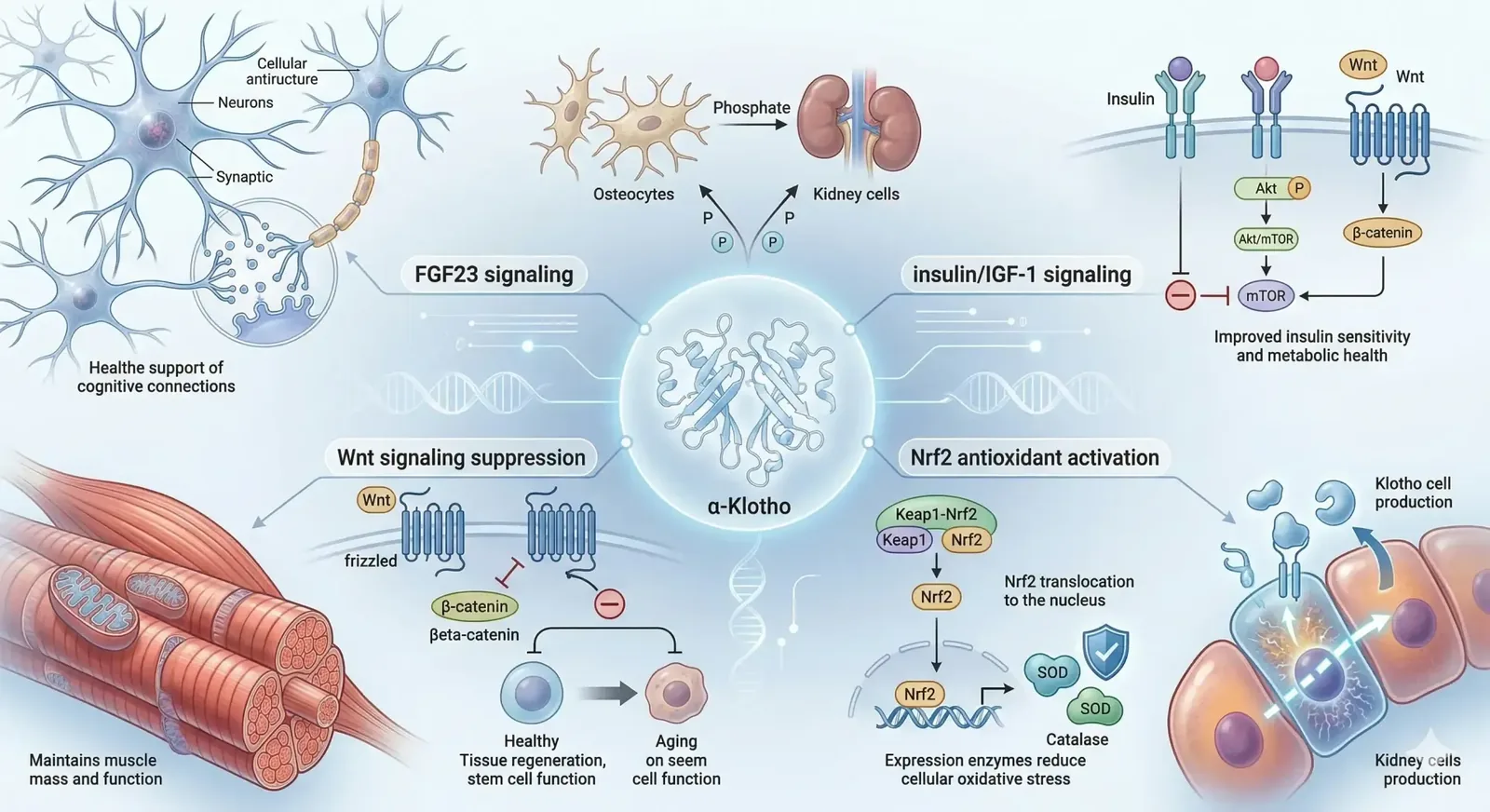
Alpha-Klotho is a protein produced primarily in the kidneys that circulates in a soluble form throughout the body. It functions as a co-receptor for FGF23 signaling, plays a role in phosphate and calcium metabolism, and exerts downstream effects on insulin sensitivity, oxidative stress response, and tissue aging. Serum soluble Klotho is lower at older ages, and healthy children carry markedly higher levels than adults [1]. Falling Klotho has also been linked to kidney decline, vascular calcification, and cardiovascular risk [2].
That profile makes it an obvious target for longevity-oriented researchers and biohackers. The question driving most of the current interest is whether artificially elevating Klotho activity, either through protein supplementation or engineered peptide constructs, can slow or reverse any of those age-associated processes.
The Problem with Native Klotho Protein
Soluble alpha-Klotho is a large protein. That size creates practical problems for injectable applications: poor bioavailability, rapid clearance, and significant manufacturing complexity. Full recombinant Klotho protein has been tested in preclinical models with compelling results, but translating that into a stable, injectable compound for human-adjacent use has remained a substantial technical hurdle.
Modified peptide constructs address some of those limitations. No peer-reviewed pharmacokinetic or stability data have been published for the engineered Klotho peptides that vendors sell. Albumin binding is one design rationale: in other peptides, attaching to circulating albumin slows clearance, but that effect has not been shown for any Klotho peptide. These constructs are currently available as research-grade compounds from suppliers like Biolongevity Labs, where they are sold strictly for laboratory and research use.
Mechanism of Action: What Klotho Peptides Are Thought to Do
Klotho's biological influence is broad, which is part of what makes it interesting and part of what makes it difficult to study cleanly. The mechanisms currently being investigated include:
- FGF23 co-receptor activity. Alpha-Klotho works alongside fibroblast growth factor 23 to regulate phosphate excretion and vitamin D metabolism. Disruption of this axis is associated with vascular calcification and kidney decline in aging populations.
- Insulin and IGF-1 signaling modulation. Klotho has been shown to suppress insulin and IGF-1 signaling in certain cellular contexts, an effect that overlaps with mechanisms associated with caloric restriction and longevity in animal models. A mitochondrial-derived peptide studied along similar metabolic and longevity lines is MOTS-c, which prevented age-related and diet-induced insulin resistance in mice, in part through AMPK activation [3]. See the guide to MOTS-c, the mitochondrial metabolic modulator.
- Wnt signaling suppression. Elevated Wnt activity is implicated in fibrosis and tissue senescence. In cell culture, Klotho bound several Wnt proteins and suppressed their activity, and tissues from Klotho-deficient mice showed increased Wnt signaling, so the authors described Klotho as a secreted Wnt antagonist [17].
- Nrf2 and FoxO pathway engagement. Both pathways are central to antioxidant defense and cellular stress resistance. In mammalian studies, Klotho activated FoxO factors and induced manganese superoxide dismutase [4], and Nrf2 knockdown reversed its protective effects [5]. A more directly mitochondria-targeted research peptide studied for the same oxidative-stress axis is SS-31, which binds cardiolipin at the inner mitochondrial membrane. See the guide to SS-31 (elamipretide) for mitochondrial oxidative stress.
- Synaptic plasticity and neuroprotection. In brain tissue specifically, Klotho has been associated with enhanced synaptic function and reduced neuroinflammation. This mechanism is what drives the cognitive angle of biohacker interest.
What the Preclinical Research Shows
Animal studies form the core of what is currently known about Klotho's effects at elevated levels. Mice engineered to overexpress Klotho lived longer than normal mice, and in that work Klotho repressed insulin and IGF-1 signaling, a pathway tied to longer life across species [6]. Conversely, Klotho-deficient mice develop a phenotype that closely resembles accelerated aging [16].
More relevant to biohacking interest are intervention studies rather than genetic models. In mice, alpha-Klotho supplementation enhanced functional regeneration of aged muscle [7], a peripherally administered Klotho protein fragment induced cognitive enhancement in young and aging animals [8], and Klotho treatment improved bone microstructural parameters associated with osteoporosis [9]. A frequently cited nonhuman primate study found that a single low dose of Klotho improved memory in aged rhesus monkeys, while a higher dose did not [10]. That result, while preliminary and limited to a small study population, has been widely referenced in longevity communities as evidence of cognitive potential.
In a mouse study, AAV9 gene therapy for secreted Klotho given to 12-month-old male mice raised median survival by 15 percent and total longevity by about 20 percent [9]. Treated mice also showed better physical fitness, bone structure and markers of adult neurogenesis [9]. Results of that nature in animal models generate significant interest, though the translation to human physiology remains unproven.
Human Trials in Progress
The transition from preclinical evidence to human data is underway, though early.
Klothea Bio is developing AKL003, an alpha-Klotho mRNA packaged in lipid nanoparticles. Its randomized, placebo-controlled Phase 1b trial plans to enroll about 21 adults aged 50 to 75, with safety and tolerability as the primary goal; as of October 2026 the registry lists it as not yet recruiting [11]. This represents one of the first efforts to systematically evaluate Klotho augmentation in humans.
Minicircle, a gene therapy company, ran a pilot trial in 14 healthy adults aged 50 to 80 combining Klotho and follistatin plasmid gene therapy, injected under the skin of the abdomen at a clinic in Honduras [12]. The registry lists it as completed in April 2026, with no results posted [12]. Its primary outcomes are serum Klotho and follistatin levels and adverse events, while cognitive tests and epigenetic age are secondary outcomes [12].
Klotho Neurosciences, which trades on NASDAQ under the ticker KLTO, is advancing secreted Klotho (s-KL) as a candidate for neurodegenerative disease indications, with presentations at biotech forums in early 2026.
All remain in early safety and feasibility phases.
What Biohackers Are Using
In the absence of approved human therapeutics, biohacker interest has concentrated on research-grade injectable Klotho peptide constructs. These are not approved for human use and are not intended to be. The exact composition of these research compounds is not documented in peer-reviewed literature, and no registered clinical trial has tested their pharmacokinetics or safety in humans.
Vendors supplying the research market offer alpha-Klotho peptide variants, AlphaKlothoLR among them, with documented purity levels verified by third-party testing. Biohackers who adhere to source quality in the research peptide space treat a third-party certificate of analysis as a baseline necessity.
Biolongevity Labs publishes a certificate of analysis for each batch and manufactures within the US. Our review of Biolongevity Labs reads those certificates against the criteria Project Biohacking scores.
Biolongevity Labs keeps AlphaKlothoLR as a standing SKU rather than an intermittent drop. Enter the Biolongevity Labs promo code PROBIO15 at checkout and 15 percent comes off the order, and Project Biohacking's code also applies on top of sale prices.
Many research peptide stores run a sale as an automatic coupon that takes the cart's only code slot. Whether peptide promo codes stack with a sale depends on each vendor's checkout rules.
Interest in Klotho peptides has also grown in the context of combination approaches. Some longevity-focused researchers are exploring Klotho alongside follistatin-related compounds for potential muscle and cognition synergies, though this remains speculative and outside any established research framework.
The Cognitive Angle
Of all the areas where biohackers are focused, cognition draws the most consistent attention. The aging brain loses synaptic density, increases in neuroinflammatory activity, and accumulates the kind of cellular stress that Klotho's known mechanisms appear to counteract. Hippocampal function specifically, which underlies memory consolidation and spatial reasoning, shows Klotho-responsive changes in animal models.
Whether those changes translate to meaningful cognitive outcomes in humans is the key unanswered question. The primate data provides directional evidence. The human trial designs being used by Klothea Bio and Klotho Neurosciences suggest that researchers consider the signal worth pursuing at significant investment. For now, the biohacking community is operating ahead of that data curve.
Sarcopenia and Muscle Preservation
Sarcopenia is a muscle disease in which low muscle strength is a key characteristic [14]. In an MRI study of 468 adults, absolute muscle mass began to fall noticeably at the end of the fifth decade of life, mostly in the lower body [13], and sarcopenia, a muscle disease, is common among older adults [14]. Klotho's role in muscle biology involves both direct effects on muscle progenitor cell activity and indirect effects through its modulation of inflammation and oxidative stress, both of which impair muscle repair and regeneration.
In mice, raising Klotho improved muscle regeneration after injury [7] and, with gene therapy, improved physical fitness and reduced muscle fibrosis [9]; both results come from mouse studies. The mechanisms are consistent with what is known about Klotho's pathway activity. This makes muscle preservation one of the more biologically coherent targets for Klotho research, even if human data remains absent.
Where the Research Stands and What to Watch
Injectable Klotho peptide research is at an inflection point. The foundational animal data is compelling enough to justify human trials, and those trials are now running. The biohacking community is moving ahead of that trial timeline, as it typically does with research-grade compounds that have strong preclinical signal and accessible sourcing.
The next meaningful developments will come from the Klothea Bio Phase 1b readout and the Minicircle trial data, both of which are expected to produce initial safety and biomarker data within the next one to two years. How those results land will determine whether Klotho moves into mainstream clinical development or remains a longevity research target with an engaged but self-experimenting user base.
Sourcing Research-Grade Alpha-Klotho Peptides
Alpha-Klotho is not a compound where source quality is optional. Because the engineered peptide constructs circulating in the research market vary significantly in purity, stability, and albumin-binding characteristics, the difference between a tested batch and an untested one shows up directly in whether the compound behaves as expected at the bench. Third-party HPLC and mass spectrometry data matched to the specific lot number is the minimum bar.
Biolongevity Labs is the vendor most commonly referenced in the Klotho research peptide space because they stock AlphaKlothoLR as a standing SKU rather than an intermittent drop, publish per-batch certificates of analysis, and manufacture within the US. To put the unit size in context, an AlphaKlothoLR vial holds far less peptide than most catalog peptide vials. No human dose has been established for any Klotho peptide. Project Biohacking's code PROBIO15 takes the discount off AlphaKlothoLR at Biolongevity Labs.
For researchers building broader bioregulator stacks around Klotho, the same vendor also carries Cartalax, Epitalon, Pinealon, and Vilon peptides, see the full Biolongevity Labs review and catalog breakdown for comparative pricing and current availability. Of those, Vilon is the Lys-Glu dipeptide of the Khavinson set, described as immunomodulatory and studied in cell culture for how it shifts gene expression in aging human stem cells [15]. See the full guide to the Vilon KE immune-aging bioregulator.
Pinealon is the member of that set whose main area of interest is the central nervous system, a tripeptide written Glu-Asp-Arg and also called the EDR peptide. In rat brain cells under oxidative stress it limited the build-up of reactive oxygen species and reduced cell death. Our guide to this Pinealon bioregulator covers that evidence and the one published human dose.
For those tracking this space through a sourcing and quality lens, theProject Biohacking peptide dosage calculator provides a structured tool for working through research compound parameters.
This page may contain affiliate links. We only recommend vendors whose third-party testing documentation we've independently verified.
What is injectable Klotho peptide?
Injectable Klotho peptide refers to engineered peptide constructs derived from the alpha-Klotho protein, designed to mimic or enhance its biological activity. These compounds are sold as research-grade materials and are not approved for human therapeutic use.
Why is Klotho associated with longevity?
Healthy older adults carry less soluble alpha-Klotho in their blood than younger people [1], and low Klotho is tied to kidney decline, vascular calcification and cardiovascular risk [2]. In mice, extra Klotho from a transgene extended lifespan [6], and gene therapy for secreted Klotho extended lifespan and improved physical fitness and bone structure [9].
What do Klotho peptides do in preclinical research?
In animal models, elevated Klotho levels have been associated with improved cognitive function, reduced sarcopenia, better bone density, suppressed neuroinflammation, and extended lifespan. The mechanisms involve FGF23 signaling, insulin pathway modulation, Wnt suppression, and Nrf2 and FoxO pathway activation.
Are there any human trials for Klotho?
Yes. Klothea Bio's Phase 1b trial of an mRNA-based Klotho therapy in healthy adults is registered but not yet recruiting [11]. Minicircle's pilot of Klotho and follistatin plasmid gene therapy was completed in April 2026, and no results have been posted [12]. Neither trial has posted efficacy results [11][12].
What is the difference between soluble Klotho protein and injectable Klotho peptide?
Soluble Klotho is the circulating form: the extracellular part of the membrane-bound protein, cut off and released into the blood [2]. Vendors describe Klotho peptides as shorter engineered sequences with modifications such as albumin binding, but no published pharmacokinetic or stability data show that those changes help.
Where can researchers source Klotho peptides?
Research-grade injectable Klotho peptide constructs are available from suppliers such as Biolongevity Labs, which provides USA-manufactured compounds with third-party certificate of analysis documentation. These are available for research use only and are not intended for human administration.
References
- Yamazaki Y, Imura A, Urakawa I, et al. Establishment of sandwich ELISA for soluble alpha-Klotho measurement: Age-dependent change of soluble alpha-Klotho levels in healthy subjects. Biochem Biophys Res Commun. 2010;398(3):513-8.
- Lu X, Hu MC. Klotho/FGF23 Axis in Chronic Kidney Disease and Cardiovascular Disease. Kidney Dis (Basel). 2017;3(1):15-23.
- Lee C, Zeng J, Drew BG, et al. The mitochondrial-derived peptide MOTS-c promotes metabolic homeostasis and reduces obesity and insulin resistance. Cell Metab. 2015;21(3):443-54.
- Yamamoto M, Clark JD, Pastor JV, et al. Regulation of oxidative stress by the anti-aging hormone klotho. J Biol Chem. 2005;280(45):38029-34.
- Xu Y, You J, Yao J, et al. Klotho alleviates oxidative stress and mitochondrial dysfunction through the Nrf2/HO-1 pathway, thereby reducing renal senescence induced by calcium oxalate crystals. Urolithiasis. 2025;53(1):61.
- Kurosu H, Yamamoto M, Clark JD, et al. Suppression of aging in mice by the hormone Klotho. Science. 2005;309(5742):1829-33.
- Sahu A, Mamiya H, Shinde SN, et al. Age-related declines in alpha-Klotho drive progenitor cell mitochondrial dysfunction and impaired muscle regeneration. Nat Commun. 2018;9(1):4859.
- Leon J, Moreno AJ, Garay BI, et al. Peripheral Elevation of a Klotho Fragment Enhances Brain Function and Resilience in Young, Aging, and alpha-Synuclein Transgenic Mice. Cell Rep. 2017;20(6):1360-1371.
- Roig-Soriano J, Edo A, Verdes S, et al. Long-term effects of s-KL treatment in wild-type mice: Enhancing longevity, physical well-being, and neurological resilience. Mol Ther. 2025;33(4):1449-1465.
- Castner SA, Gupta S, Wang D, et al. Longevity factor klotho enhances cognition in aged nonhuman primates. Nat Aging. 2023;3(8):931-937.
- Klothea Bio Inc. aKLmRNA-mediated Protein Replacement Therapy. ClinicalTrials.gov NCT07544420.
- Minicircle. Safety and Efficacy of Klotho and Follistatin Gene Therapy. ClinicalTrials.gov NCT07285629.
- Janssen I, Heymsfield SB, Wang ZM, Ross R. Skeletal muscle mass and distribution in 468 men and women aged 18-88 yr. J Appl Physiol (1985). 2000;89(1):81-8.
- Cruz-Jentoft AJ, Bahat G, Bauer J, et al. Sarcopenia: revised European consensus on definition and diagnosis. Age Ageing. 2019;48(1):16-31.
- Khavinson VK, Linkova NS, Ashapkin VV, et al. KE peptide regulates SIRT1, PARP1, PARP2 gene expression and protein synthesis in human mesenchymal stem cells aging. Adv Gerontol. 2023;36(3):302-312.
- Kuro-o M, Matsumura Y, Aizawa H, et al. Mutation of the mouse klotho gene leads to a syndrome resembling ageing. Nature. 1997;390(6655):45-51. doi:10.1038/36285
- Liu H, Fergusson MM, Castilho RM, et al. Augmented Wnt signaling in a mammalian model of accelerated aging. Science. 2007;317(5839):803-6.
a-Klotho FAQ
About the Author
Jeff Nunn is the founder of Project Biohacking. With over 30 years of biohacking practice, he applies decades of self-experimentation methodology to peptide research, dosing math, and vendor evaluation.
Important Disclaimer: The content on Project Biohacking is for educational and informational purposes only and is not intended as medical advice, diagnosis, or treatment. Always consult a qualified healthcare professional before making any changes to your health regimen, starting new supplements, peptides, or protocols. Nothing on this site establishes a doctor-patient relationship, and you use the information at your own risk. Research compounds discussed here are sold for laboratory research purposes only and are not approved for human or veterinary use or consumption.